Wednesday, 20 March 2013

20th March - Spring migration gathers pace

Hi all,

As you can imagine, the last week has been quite hectic with the dowitcher remaining at least until yesterday, and I've been able to renew old aquaintances with people I've not seen since the last 'mega' here in Murcia, the Belted Kingfisher (also a 1st for Spain) back in 2009/2010.  Although not on a level with the UK where number of birders would be in the 1,000's, I should imagine that a couple of hundred people have made the trip here to see the bird (including one person who set out from Barcelona on the Monday afternoon, called in at Lugo (Galicia) for Thayer's Gull and then went for American Herring Gull also in Galicia on Tuesday before getting to Murcia on the Wednesday morning for the Dowitcher.  He reckoned that he'd have done around 3,000 km by the time he got home).  That brings back memories of bygone years, birding in the UK!  There may not be the number of twitchers here in Spain as in the UK, but they've got the same mindset!  And with Moussier's Redstart and Red-flanked Bluetail having been seen over the last few days in Spain, I've been tempted - maybe I'll just try to find more out about a Wallcreeper in the south of Murcia seen a couple of days ago and have a look for that!

Apart from various visits to San Pedro del Pinatar, I have managed to get out to some of my more local spots, and as the title to the entry suggests, more and more migrants can be seen.  (It is the first day of Spring today, after all!).  It's rare now not to see Barn and Red-rumped Swallows and House and Sand Martins about, and all three species of swift have now been seen locally (Common, Palid and Alpine), although they're not yet common.  Also, many winter species seem to have gone (for example, I've not seen the Velvet Scoters since the 8th March).

Calling in to the Mar Menor at the Marina de Carmoli area on friday afternoon (15th March), 3 Common Scoter remained including a now obvious male, together with a fair group of Great Crested (27) and Black Necked Grebes (19), and in the mixed flock were a single female Pochard  and a pair of Red Crested Pochard.  It's not often you see Red Cresteds on the Mar Menor, nor do they breed around this area so I assume they were just resting up on their way further north.
I spent the rest of the afternoon at San Pedro, where in the canal surrounding the salinas I saw a single female Mallard with 13 ducklings - the first 'young of the year' I've seen.

 San Pedro is good for more than just one wader - here a group of Sanderling...

...on the Mediterranean side of the salinas

 A bit in the shadows, mother Mallard and ducklings

The following day I called in to the lighthouse garden at Cabo de Palos (this year I'm not going to be going there with the frequency of the previous 4 years, probably just a couple of times a week).  Here there were obvious signs of movement, with 9 Robins, 7 Black Redstarts and 6 Hoopoes flying around the base of the lighthouse, whilst out at sea I had Common Redshank fly past north and an adult Gannet go south.  Also, a pair of Kestrels mating on a rock ledge.

 Not voyeurism - with the noise they make, you can't help but look

A couple of male Sardinian Warlers trying to out-do each other

From here I called in at the Marina de Carmoli, more than anything to see if the R.C.Pochard were still about.  They weren't, but the group of Common Scoter was up to 9 birds (with 2 males) and over the Marina itself were 3 Marsh Harriers with a further 3 more distant raptors circling of which one was a Booted Eagle, and probably the other two as well.

Calling in next at the rambla de Albujon, there was a group of 10 noisy Black Winged Stilts, a pair of Little Ringed Plovers, 2 Green Sandpipers, a Redshank, 4 Common Snipe and a single Jack Snipe.
There were also a couple each of Sand and Crag Martins (the Crag Martins are getting scarce now while the other hirundines increase in numbers) and four Swallows, plus 4 Iberian Wagtails, 2 White Wagtails and a single Water Pipit now coming into breeding plumage with its pink breast and white supercillium.

From here I went on to San Pedro, but there was nothing new (how blasé - just a Short-billed Dowitcher, 1st for Spain!).
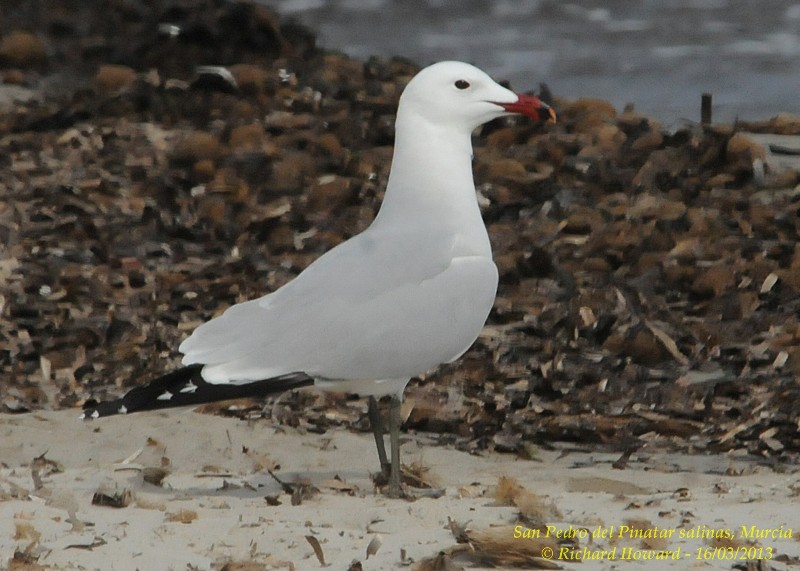
 On the beach, Audouin's Gull...
 And Slender-billed Gulls and Sanderlings...
 ... meanwhile in the canal, very showy Little Egrets

On the sunday I'd arranged to meet some people at San Pedro so went straight there and stayed all morning, seeing quite a reasonable list of waders (Avocet, Black Winged Stilt, Slender-billed Dowitcher, Common Sandpiper, Little Stint, Dunlin, Green Sandpiper, Sanderling, Turnstone, Black-tailed Godwit, Redshank, Spotted Redshank, Greenshank, Grey Plover, Little Ringed Plover, Ringed Plover, Kentish Plover, Ruff) plus Kingfisher and a very smart Penduline Tit, and a new bird for the year, Common Swift (I'd only had unidentified Common/Pallid up until then).

A Spanish twitch!

...and the object of the twitch

 There WERE other waders around - here Spotted Redshank beginning to moult into b.p...

 ...Common Redshank...
 ... and Black-tailed Godwit
On monday (18th March) with clear skies and hardly any wind, I had another early look around the lighthouse gardens at Cabo de Palos before going to work. I had Sand Martin and a group of four Alpine Swifts fly over, and migrants on the ground were 3 Black Redstart, 2 Chiffchaff, a single Hoopoe, 2 Northern Wheatears, 4 Chiff/Willows, and new for the year, my first Willow Warblers (3) and Common Redstart (1).  There were also Swallows and a single Red-rumped Swallow flying about, but I think these may have been local birds as they were singing.

Tuesday (19th March) is a holiday (Fathers Day) in Spain, so I had the whole day to go out.  As it was again cloud and wind free, I started off at the San Pedro salinas, in the hope that the rush might be over and I might get to see the Dowitcher close, as the last few sightings have all needed a telescope.  I had no luck here as it kept to the far edge of the lagoon, but I met up with a crowd of birders from Cartagena and we had a look around the rest of the salinas and reserve.  I should explain here for those that don't know the area, apart from being a working 'salinas', it is also part of a national park and there is a reasonable sized area of coastal pines growing in the sand dunes.  Walking around these, we had a very smart male Black-eared Wheatear, male Common Redstart, Bonelli's Warbler (1st for the year) and male Subalpine Warbler (also 1st for the year).

In the afternoon, as there had obviously been a fall of sorts, I called into Calblanque, which is close to my home.  On my way to the carpark area, I had my first Woodchat Shrike of the year, and in the trees at the side of the carpark, another male Subalpine Warbler and six Chiff/Willows.  I went over to the salinas (of Rasall) to have a hunt through the Audouin's Gulls for colour rings.  There were 203 gulls, and I managed to read 13 rings, and here I had another male Black-eared Wheatear.

Lastly, as I just about had time, I called into the lighthouse gardens (Cabo de Palos) staying until it was almost dark.  Here I had my 3rd Subalpine Warbler of the day, plus 3 more Black-eared Wheatears and a single Northern Wheatear, but the most interesting sighting was an actual 'flock' of 11 Hoopoes.  Presumably they'd come in late on during the day, as being a holiday there'd have been a fair bit of disturbance there and they wouldn't have stayed.  Fascinating to watch them flying around like giant butterflies as the light went.

And that's about it for the moment, apart from I've managed to sort out some short video I took of the Short-billed Dowitcher on the 10th March, which you can see here.


Chauu!
 

Thursday, 14 March 2013

14th March - It's official - It's a Short-billed Dowitcher, first for Spain!!

Hi all,

Just a quick update entry.

After some investigation work, the Dowitcher at San Pedro del Pinatar has finally been identified, as a winter plumage, probably female, Short-billed Dowitcher - first record for Spain!!

First, my congratulations to Francisco Javier Palacios Garcia (Javi) and Isabel Peñalver (Isa) on finding the bird.

I have made a short write-up as to how I got the identification, on a button on the right of this page.  For anyone interested in seeing the bird, which was still there as of yesterday afternoon (Wednesday, 13th March), it can be found either in the canal that surrounds the San Pedro salinas in El Mojon (somewhere around the wooden footbridge that crosses the canal just before it empties into the Mediterranean), or in the corner of the nearby salinas lagoon.

Other, more mundane news - spring passage continues, with hirundines now being seen frequently, and the other early migrants also around, if you can get out of the wind to see them!  Birds seen of note during the first few days of this week have been a single Alpine Swift on Tuesday 12th at El Mojon, San Pedro del Pinatar (wonder what I was doing there!).

Yesterday, 13th March I had my first Pallid Swift over the skies at the old sewage works (EDAR) at El Algar, with another Pallid or Common Swift in the afternoon at the lighthouse at Cabo de Palos.  Also scrabbling around the rocks at the base of the lighthouse was a very nice male Blue Rock Thrush, and the first Northern Wheatear I've seen there this year.

 Distant, but still smart, male Blue Rock Thrush
Not so distant and very smart, this male Northern Wheatear

And that's about it, from a sunny but windy Murcia.

Chauu

Monday, 11 March 2013

11th March - local roundup - migrants and a surprise

Hi all,

What with bad weather and commitments, I didn't manage to get out this last week until Thursday 7th, when with overcast skies and a south-easterly breeze blowing, I took an early morning look at the lighthouse garden at Cabo de Palos.

Here, apart from the usually expected birds, new in were a male Spectacled Warbler seen briefly, a female Blackcap, and on the rocks at the base of the lighthouse, a single Whimbrel.

On the rocks below the lighthouse itself, a Whimbrel

In the afternoon, I took a look around the western corner of the Mar Menor, stopping at Punta Brava, the Marina de Carmoli, and the 'desembocadura de la rambla de Albujon'.
The beach area at Punta Brava (from Los Urrutias, take the last right turn before leaving Punta Brava) occasionally has a few waders, especially around the pools that have formed next to the breakwater, and here I had a couple of Cormorants resting up, together with Turnstones, Dunlin and Ringed Plover, together with singles of Black-headed and Slender-billed Gulls, both adults and looking resplendent in their respective breeding plumages.  Out on the Mar Menor, a large group of Black-necked Grebes many of which are also now in their breeding plumage, and a single Great Crested Grebe.

I always find these Cormorants in their breeding plumage quite comical

A look over the Mar Menor from the Marina de Carmoli (park at the lay-by at the km.8 road sign and walk down to the beach) produced 7 Common Scoter (a male and 6 female), a group of 12 Great Crested Grebes and another of 9 Black-necked Grebes.  Meanwhile, over the Marina itself, 3 Marsh Harriers were quartering, including a spectacular looking adult male - just black, white, light grey and brown, always a pleasure to watch.

As I parked up at the 'desembocadura' I noticed a group of ducks flying west into the bay area, black with flashes of white, so getting the 'scope out I got onto them - the group of 6 Velvet Scoter that have made this area their home for the past month or so now.  Also in the bay were more Great Crested Grebes (15 of them), Black-necked Grebes (25), and from the rambla the group of Coot (today only 6) that scuttle for the open water whenever anyone goes up the rambla. On the sandbar across the rambla mouth were 14 Cormorants which also made a mad dash for the water.

 Absolute panic sets in whenever Cormorants are caught out unawares

I walked up the rambla as far as the N-332 road bridge and had a look at the other side, but as they skies by now were looking threatening and I didn't want to get caught in a shower, I decided against walking the rambla.  From the bridge there were a couple of Water Pipits, a Grey Wagtail and a single ale Bluethroat amongst the smaller birds, and a group of 14 Black Winged Stilts, 2 Common Snipe and a Green Sandpiper made up the waders to be seen.

The following day, Friday the 8th March, as there had been showers overnight but it was beautifully cloudless morning, I again went to the lighthouse garden at Cabo de Palos.  If the floodgate for migrants hadn't opened, at least it had been cracked slightly.  There were birds everywhere - not necessarily what you might think of as migrants as many winter here - but they were migrants nonetheless.  My final tally after wandering around for an hour and a half was:  Robin - 3; Sardinian Warbler - 11; Hoopoe - 3; Black Redstart - 23; Blackbird - 8; Chiffchaff - 20; Greenfinch - 2; Songthrush - 11; Meadow Pipit - 2; Swallow - 1; Spectacled Warbler - 1; Serin - 5; Crag Martin - 2; Red-rumped Swallow - 1, plus out to sea, a single Gannet and Audouin's Gull.

 Not particularly common on passage, but a few Meadow Pipits are seen most years at the gardens
 
 I'm not the only one eager for spring passage to start!
 
The first decent passage day brought many Black Redstarts

On the way back to Los Belones, I called in briefly to the 'Marchamalo salinas' (saltpans of La Manga, behind the go-kart track). Here now, the water levels are very high, and the only birds of note were a group of 21 Greater Flamingos new in.

In the afternoon, as it was a bright, although by now breezy, afternoon I  called in to the rambla de Albujon again. At the desembocadura, a surprise bird was a Little Grebe - although common in the farm reservoirs, it's unusual to see them on the Mar Menor.  Also there, the Cormorants, Coots and Great Crested Grebes, and a Kingfisher.

 Once again, one of the 'punk' Cormorants

 Common over the last month or so, Great Crested Grebes...

 ... whereas much more unusual, this Little Grebe

 On passage at the moment, Black Winged Stilts...

 ... whereas Coots used to be much more common over the early part of the year

Always present over the winter, at least one Kingfisher


I walked the rambla de Albujon as far as the AP-7 motorway bridge, and sat down there for half an hour in the hope I might see a Spotted Crake (which I didn't).  However I did see my first Sand Martin of the year and a couple of House Martins and 4 Swallows in amongst the Crag Martins.  Other birds of note were 6 Common Snipe and a Jack Snipe, Water Pipit, 3 species of wagtail (White, Grey and Iberian) and Fan-tailed Warblers (or Zitting Cisticolas if you prefer) singing their hearts out in the breeze.

On Saturday 9th, I went inland around Fortuna but the only birds of note were a single Crested Tit, a couple of Dartford Warblers singing, Chiffchaff singing and various Crested/Thekla Larks (seen at the sides of the road, so I couldn't stop to i.d. them), and a large band of Jackdaws.

 Not that they're particularly rare, but it's not that frequent that they're so photogenic...
 
 ... and Crested Tits aren't so easy to photograph either, as they're normally in the shade

Coming back in the afternoon, I decided to call in to the salinas at San Pedro del Pinatar, as I hadn't been there for quite a while.  Here I saw all the usual birds (Greater Flamingo, Shelduck, Mallard, Black Winged Stilt, Avocet, Redshank, Spotted Redshank, Black-tailed Godwit, Turnstone, Little Stint, Sanderling, Black-necked Grebe, Little Egret), and a couple of distant Spoonbills.  I sat by the entrance to the salinas for a while and was rewarded with seeing a Kingfisher going to and fro across the road several times, and a group of four Penduline Tits which came to the reeds close to where I was sitting.

 Almost at the roadside was a Black-tailed Godwit feeding in the reeds
 
 The canal that surrounds the salinas is always worth a look - this time a Redshank

 Sitting quietly pays off - here a record shot of a Penduline Tit

I had intended to go home via the 'Marina de Carmoli' to see how the harrier roost was doing, but I bumped into someone who told me that at the beach end of the salinas, he had seen some wheatears, so I decided to take a look.  Sure enough, from the wooden boardwalk that runs from the car park where the never-open information centre is, I first saw one, then two wheatears, but they were male Black-eared, not what I had expected.  Then, while watching them, a male Northern Wheatear popped out of no-where!  I don't know what it is - probably has something to do with birding in the UK, but I always feel that spring migration is REALLY here when I see my first Wheatears, although they're rarely the first migrants I see nowadays.  Anyway, male Black-eared Wheatears - always nice to see in their spanking plumage!

 Down at the beach at last knockings - a record shot of male Northern and Black-eared Wheaters
 
 ... and here the Black-eared Wheatear joined by another...

 ... here a closer view of one of them

 Again, on my way back I bumped into some other birdwatchers that I'd seen earlier and who had told me they were going to do a loop along the canal to El Mojon and back.  I stopped to tell them about the wheatears and one of them (Javi) asked my opinion on a wader he had photographed.  What ran through my mind initially was that it was a winter plumage Spotted Redshank, except there were things that didn't fit - the bill was too thick and didn't droop at the tip; general coloration not contrasting enough and the leg colour was wrong - they were a greeny colour. Javi then showed me another photo of the bird with a Black Winged Stilt in the background, and I could see it was much too small for a 'shank.  Whatever it was, it wasn't a normal wader for around here, so after asking where he'd seen it, I told him I'd let him know, and I zoomed round to the place.  However by the time I got there it was getting dark, so I thought I'd have another look in the morning.  This had the advantage of allowing me to do some research overnight, when I came to the conclusion that it was a Dowitcher, but which flavour?

So guess where I was on Sunday morning!  I spent 2 hours there, taking over 1,000 photos and a couple of videos, (not all of them were of the Dowitcher) but I'm still not sure whether the bird's a Long-billed or Short-billed Dowitcher, although I do now err on the side of Short-billed.  (I've also sent photos to various people to comment, but am getting mixed replies).  So, if you know your waders, have a look at the photos and let me know!  (By the way, although I spent 2 hours with the bird yesterday morning, it didn't once call, which is a real shame!).

 
 Here the object of the exercise - the Dowitcher with a Sanderling to give an idea of size
 
 Not all my time was spent photographing the Dowitcher - here an adult, breeding plumage Mediterranean Gull
 
 ... and here a Turnstone...

 ... here the Med. Gull amongst a group of Slender-billed Gulls..

 ... and here, one of those Slender-billed Gulls in close-up

 
 Meanwhile, back at the subject of the exercise, the dowitcher with Sanderlings, showing it's marked breast...

 ... another of it, this time in flight...

 ... and this time, when it came close...

 ... together with some of the other waders...
 
 ... and another of it in flight

 Meanwhile in other parts of the salinas, this breeding plumage Black-tailed Godwit

After spending most of Sunday afternoon sorting out the photos taken in the morning, I took a quick look again at the Cabo de Palos lighthouse garden, spurred on by the appearance of the wheatears in the afternoon at San Pedro.  It was very quiet here though, although there were still quite a few (8) Black Redstarts about, and definitely more (7) Stonechats than normal.


And that's about all - the birds are coming in, still slowly at the moment, and the weather forecast for the rest of the week isn't brilliant, but what the hell it's springtime and anything could turn up!

Chauu

Monday, 4 March 2013

4th March 2013 – Local roundup


Hi all,

Another week when the weather hasn’t been at all settled.  We’ve had days of sun, but also light rain, heavy showers and hail, with wind predominantly from the north west  - and judging from the long-range weather forecast, things won’t be changing anytime soon.  On the national TVE weather forecast on the 1st March, they gave an overall forecast for the next 3 months (March, April and May) showing persistent high pressure over the north of the British Isles forcing low pressure systems to track east from the Atlantic further south than usual, with associated fronts moving continually over Spain.  In simple terms, lots of cloud and rain from the west!  We’ll see!

Birdwise, there has once again been very little movement of migrants, and most of the winter birds are still around.  There have been a few reports in Murcia of Short-toed Eagles being seen, and at the Rambla de Albujon on Tuesday 26th February, I had my first ‘Yellow’ Wagtails of the year (actually Iberian – the blue-headed with white supercillium and chin, types), and in a group of Crag Martins feeding over the rambla, a couple of Red-rumped Swallows.  On the same afternoon, I had what was probably my last sighting of the Red-throated Diver in the Mar Menor (not seen since), and the group of 9 Common Scoter, all at the km.8 of the F-34 just west of Los Urrutias/Punta Brava.  Also on the same day just prior to sunset, 40 minutes at the harrier roost at the ‘marina de Carmoli’  produced me a couple of Hoopoes, at least 5 Marsh Harriers and a single ‘ringtail’ Hen Harrier, but no sign of the Pallid Harrier.

 Probably my last sighting of the Red-throated Diver

 The 'winter' hirundine locally - Crag Martin

One of the early migrants, 'Iberian' (Yellow) Wagtail

On Thursday 28th February early afternoon, after rain in the morning, I took a little trip over to the Cabo de Palos lighthouse garden, in the hope that the rain might have forced some birds down, but it seemed to be quieter than normal, the only birds that might have been migrants (as opposed to winter visitors or residents) being a couple of Stonechats and 3 Black Redstarts.

On Friday 1st March, after rain and hail in the morning, as the sky had cleared a bit, I called in once again at the Mar Menor to see if I could find the Red-throated Diver.  I had no luck with that bird but was surprised to see single Oystercatcher on the shoreline – not a rare bird around here but definitely unusual (I normally only have two or three sightings per year locally).  Also unusual was a group of eleven Mediterranean Gulls sat on the water, all adults and many in full breeding plumage. 

 Uncommon around the Mar Menor, my first Oystercatcher locally for the year

Moving along to the ‘desembocadura de la rambla de Albujon’ scanning over the Mar Menor I was surprised to see the group of 6 Velvet Scoter that have been around over the winter – I hadn’t seen them recently and had thought they’d gone.  As always, they were a fair way out (telescope definitely required), but they seem to have a habit which maybe is an aid to distinguish them at distance – they seem to tilt their heads up in the air a lot ending up with their bills almost vertical.  Whether this is some form of aid to digestion I don’t know, but it looks quite comical, and I can’t say I’ve ever noticed Common Scoter doing this.

Saturday the 2nd March, being the first Saturday of the month, we had our monthly ‘RAM’* census – 3 hours on the cliffs at Cabo de Palos counting seabirds and mammals. 

I had intended to call into the lighthouse garden for a quick stroll before the census started, but the gates were all sealed – remedial works are being carried out so there’s currently no public access (I hope they’re not going to take too long).  So, back to the census, starting at 08:30, we had clear skies and it wasn’t too cold.  However, the numbers of birds seen wasn’t fantastic.  There was a passage of around 120 Balearic Shearwaters during about half an hour, and we were kept amused by what presumably was a family group of Shags, 2 adults, 3 immatures and 2 juveniles (which must have been just out of the nest), swimming around the rocks for about an hour.  Apart from that, we saw more than 70 Gannets, 3 well spaced out Great Skuas and a single Pomerine Skua, Cormorants, Sandwich Terns and a couple of Black-headed Gulls, and towards the end of the count, a couple of pods of dolphins, one of around 17 Bottle-nosed Dolphins and the other of 7 Common Dolphin (not that I can claim to know the difference when they’re at distance – I just noted them as ‘large’ and ‘smaller’ – luckily they people I was with DID know the difference).

 
Adult Cormorant in breeding plumage with diving Shag in the background
 
 Cormorant (L) and Shag (R) together allowing comparison of the head shapes

 The family group of Shags around the rocks

Two juvenile Shags, fresh out of the nest and looking very pale

On the way home from the RAM, I called into Marchamalo Salinas, but these were very quiet – top birds on the La Manga side being 15 Avocet and 4 Shelduck, and round at the ‘Playa Paraiso’ side, 20 Kentish Plover and 3 Little Stints.  Still, at least there was plenty of water in the lagoons.

On Sunday, 3rd March, I called in at all the usual places along the Mar Menor but saw nothing new, and then called in at the old sewage farm (EDAR) of El Algar.  I had been told that the rain over the past few days had put quite a bit of water in one of the old lagoons (that had been totally dry all autumn and winter), so I thought it might be worth a look.  And there WAS plenty of water, and waders hadn’t wasted any time in finding it.  There were 4 Black Winged Stilts, 3 Greenshank, a single Spotted Redshank and a couple of Little Ringed Plovers.  Previously when this EDAR was functioning, it used to be a magnet for waders (including Temminck’s Stints, the first Pectoral Sandpiper for the region of Murcia and a few of years ago, an Egyptian Plover), so if the water remains I’ve got high hopes for the site.

And that’s about all (as I sit here looking out of my window watching the rain falling).

Chauu


* RAM – Red de observación de Aves y Mamiferos marinos.  More details (in English) in the following link: