OK, it's not Murcia, but you've got to get out sometime..... In the form of a trip report, a trip made last weekend.
The 6th and 8th December are fiesta days here in Spain (known as the ‘puente de la Constitución), and for the last couple of years I have gone to Extremadura to see the wintering Common Cranes (Grus grus) there. This year for a change, I went with a local birdwatcher, Pepe Navarro, to another of their wintering areas, this time in the north of Spain, on the border of the provinces of Teruel and Zaragoza, the ‘Laguna de Gallocanta’. Nestling amongst cereal fields at a height of 1,000 metres above sea level with a surface area of between 0 and 1,330 hectares depending on the amount of rainfall during the previous summer, this natural lagoon is one of the first places that the Cranes come to once they have crossed the Pyrenees on their way south to winter in Spain and north Africa. Although many carry on further south, a lot of them stay in the area for the whole of the winter, and in a census taken on the day we arrived (5th December), the number counted was 37,857.
The 6th and 8th December are fiesta days here in Spain (known as the ‘puente de la Constitución), and for the last couple of years I have gone to Extremadura to see the wintering Common Cranes (Grus grus) there. This year for a change, I went with a local birdwatcher, Pepe Navarro, to another of their wintering areas, this time in the north of Spain, on the border of the provinces of Teruel and Zaragoza, the ‘Laguna de Gallocanta’. Nestling amongst cereal fields at a height of 1,000 metres above sea level with a surface area of between 0 and 1,330 hectares depending on the amount of rainfall during the previous summer, this natural lagoon is one of the first places that the Cranes come to once they have crossed the Pyrenees on their way south to winter in Spain and north Africa. Although many carry on further south, a lot of them stay in the area for the whole of the winter, and in a census taken on the day we arrived (5th December), the number counted was 37,857.
Logistics and
location
Setting out from Los Belones (Cartagena, Murcia) on Thursday 5th
December at 6:10pm and with a single short stop we arrived at Gallocanta at
11:30pm. The distance covered was 530
km. Our route was to take the AP-7 to
Alicante, then the A-31, N-340, and A-7 to Valencia via Elda and Ibi, then from
Valencia to Teruel on the A-23, continuing on the A-23 towards Zaragoza until coming off this
motorway and taking the A-1507 to Tornos, then continuing on to Gallocanta
itself. All driving was on dual-carriageways
except for the N-340 for a few kilometres on the way to Valencia, and the
A-1507 to Tornos and Gallocanta. On the
return journey on Sunday 8th December, we used the same route
leaving at just after 4:30pm, but although there was more traffic we still got
back to Los Belones just before 10pm.
The location can be seen using Google Earth by copy
and pasting the following co-ordinates in the search box 40.989717, -1.506738 (making sure that Google Earth is set to decimal degrees first), or just typing Gallocanta into the search box.
We were staying in one of many ‘Casa Rural’ in
Gallocanta itself, but there is also a hostel in the village, and we noted that
several of the surrounding villages had rooms to let.
The lake itself is in a depression and surrounded by
cereal fields (some of which were just stubble and the others currently being
ploughed during our visit). These are crossed by local roads (the A-211,
CV-633, A-1507 and A-2506) on which there are several small villages –
Gallocanta, Berrueco, Tornos, Bello and Las Cuerlas. In the villages of Gallocanta and Bello,
there are information centres (both of which were open all weekend) where any
further information can be obtained. Within the perimeter of the local roads
mentioned above, there are many mud tracks that can be traversed – we were in a
4x4, but a normal car could also have used them as there obviously hadn’t been
any rain for a while.

Map of the area - available free in the information centres
Weather
During our 3 night stay there, the weather was
excellent for viewing the Cranes apart from the night of our arrival and first
morning, when there was thick fog which cleared by midday (we were later told
that the fog was most unusual). The rest
of the time we had clear skies and no wind, with temperatures between -3º
overnight and 10º at midday in a very dry atmosphere, so the 10º at midday
seemed warm. Daylight hours were from before we got up to around 6pm!
A word of advice - if you go there, check on your antifreeze and carry an
ice-scraper!
Food and drink
The two evenings we spent at Gallocampo, we ate at the
Hostel. The food was basic but good,
although portions on the small side, with 3 courses at a set price of 9€. A word of warning though – as we were not
staying at the hostel, we had to wait until people staying at the hostel
finished their suppers before we could have ours. This was not a problem as we could wait in
the bar! Breakfast and lunch were
‘bocadillos’ which we had made up at local bars depending on where we were at
the time.
Day 1 - 6th December
After loading up the wood burning stove in the house,
we set off at around 9-30am, but had to stop shortly after as the water in the
windscreen washer had frozen and we couldn’t see through the windscreen. Not that this stopped us from seeing birds –
the thick fog everywhere did that!
Once
we got the windscreen de-iced, we set off again, taking a slow drive in an
anticlockwise direction around the local roads that surround the lagoon. Our first bird seen was an adult female Marsh
Harrier that crossed the road in
front of us and then settled on the back of a field at the side of the road –
until it saw us get our cameras out!
The next birds were groups of Corn Buntings on the
bushes at the side of the road, and then a group of mixed Spotless Starlings,
Tree Sparrows and Rock Sparrows also at the side of the road. (The only
sparrows we saw all weekend were Tree and Rock – not a sniff of House or
Spanish). We finally started to see
through the fog some Cranes also in the fields at the sides of the roads, and
snapped away frantically in case they were the only ones we were to see. We needn’t have worried!!


Our first sightings, of Cranes in the fog!
Continuing our route we had large groups of Linnets
(with the occasional Goldfinch and Greenfinch), more Spotless Starlings, Tree
Sparrows and Rock Sparrows, Kestrels, more Marsh Harriers and Hen Harrier in
some of the spots where the fog was a little less dense, together with more Cranes
on the fields. On one occasion when we
stopped to watch the Cranes in a field, I heard Black-bellied Sandgrouse
calling, the closest we got to them, but on checking Pepe’s photos after we got
back I noticed he had inadvertently photo’d a couple in a photo he took of the
Cranes!

This may look like just another photo of Cranes in the fog, but note the two birds top right
- out of focus, but definitely Black-bellied Sandgrouse
Photo courtesy of Pepe Navarro
http://marmenorenclave.blogspot.com/

Also seen in the fog, here a Hen Harrier ...

... with groups of Rock Sparrows and Linnets along the roadside ...

... plus flocks of Tree Sparrows

Funny - we saw Tree Sparrows on the rocks, and Rock Sparrows in the trees!
Photo courtesy of Pepe Navarro
http://marmenorenclave.blogspot.com/

We wern't the only ones out on the prowl in the fog
Photo courtesy of Pepe Navarro
Photo courtesy of Pepe Navarro
http://marmenorenclave.blogspot.com/

Group of Calandra Larks
Photo courtesy of Pepe Navarro
http://marmenorenclave.blogspot.com/


Another couple of Pepe's photos, of female and male Hen Harrier
Photos courtesy of Pepe Navarro
http://marmenorenclave.blogspot.com/
When we got as far as Tornos, the fog was noticeably
less dense, so we decided to stop at the bar in the village, and have breakfast
of a large ‘bocadillo’ and a beer. We
finished the circuit of the lagoon, and deciding to do a second round as the
fog had lifted, but this time to be closer to the water, when we got to the
village of Bello, we took one of the tracks down to the lagoon itself, stopping
off at the various hides and having a picnic lunch at the ‘Ermita de la Virgen
del Buen Acuerdo’ which is on a hill overlooking the lake and the village of
Gallocanta, watching the Cranes dropping in to the lagoon in groups from 30 to
150 at a time. We spent the rest of the
daylight hours driving around the mud tracks, stopping when we saw anything
interesting or photographable. We had the intention of being at the ‘Ermita’ at
around 5:15pm, but got a little lost and came across a line of trees with a
group of 5 Red Kites roosting in them. We watched these for a while, and then
noticed that in the fields behind the trees, there were several male Hen
Harriers sitting on the ground (7 in total, plus 3 females/immatures). So finally at 5:45pm we were back at the
‘Ermita’ to watch the Cranes coming in – which they did in their thousands! A rough estimate was of 15,000, but there
could easily have been a lot more. A
real spectacle. We remained there until
they seemed to stop dropping in and when it got too cold to stay any more we
retreated back to the bar in the Hostel for a few beers. Later, after downloading photos and getting
ourselves ready at our 'casa', we returned to the hostel (only about 100 metres away) for our
supper at around 10pm.


The 'Ermita Virgen del Buen Acuerdo'

View from the 'Ermita' looking over the lagoon to the village of Gallocanta


More views from the 'Ermita'


The birds we'd come to see - Common Crane - from the 'Ermita'

Here in the roadside fields ...

... and here closer to the lagoon, with the 'Reguera' observation hide in the background

The Cranes were flying over constantly ...

... but were not the only birds we saw. Here a male Hen Harrier ...

... and another photo of the same bird

and here a female


And in the evening, waiting for the arrival of the Cranes
Day 2 – 7th
December
Although the morning didn’t start with fog, and we got
the car windscreen clear with hot water, we still didn’t go out until just
after 9am – about the time some people were coming back from seeing the Cranes
go off from the lagoon. We spent the
whole day touring around, picking up groups of Skylarks and Calandra Larks, but
were at the ‘Ermita’ at around 11:30am when large groups of Cranes came off of
the surrounding fields to the lagoon itself.
Another spectacle, to see groups of up to several hundred birds in lines
coming in from the distant horizons. We
stayed there for a picnic lunch and siesta before setting off around the fields
again, and from there, looking over the hills behind Gallocanta, through the
‘scope I saw a group of four Griffon Vultures soaring, with a fifth resting on
a rock.

The 'Ermita' on top of a low hill

Another of the observation hides overlooking the lagoon - this one the 'Los Ojos' hide

The view from the hide

Part of the midday arrival ...

... and here more of the same

They just kept coming ...

... more and more of them ...

... until you lost count

The entrance into Bello, one of the villages surrounding the lagoon

The 'Bello' information centre

The centre of the village of 'Tornos'

Entering the village of Berrueco

The 'Ermita del Buen Acuerdo' again, our favourite spot

A general landscape view showing the type of terrain

The observation hide 'La Reguera' gets pretty busy early evening!


Female Hen Harrier seen on our travels

A family dispute, maybe?

In the fields, always a Carrion Crow somewhere
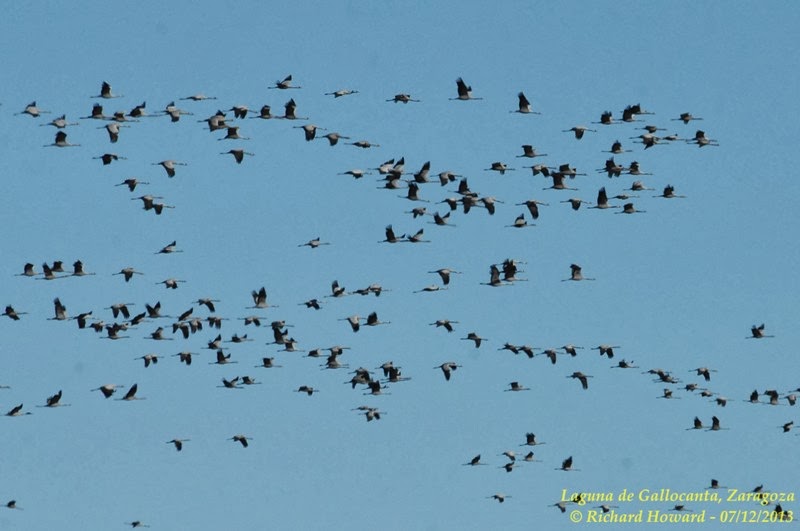


And the evening arrival of the Cranes

We didn't do too badly for raptors either - here a Red Kite ...

... and another, of one of the male Hen Harriers that were hanging about

Carrion Crow

The Cranes as seen from the hide 'La Reguera'

A couple of the Red Kites seen roosting in one of the few trees
In the fields we were looking in
particular for photographable Hen Harriers and Red Kites, but although we saw
both, they were too far for decent photos.
We called in at the hide called ‘La Reguera’ which is a stilted hide
with good light (the sun is behind you), but there were so many people on the
metallic platform that eventually we left. We finished the day again at the
‘Ermita’ at around 5pm watching the rest of the Cranes come in to the lagoon
for an hour, after which we spent the evening much as the previous evening.
Day 3 – 8th
December
Our last day, and as per the previous day, we set out
at 9am, into the fields around the lake.
Here we finally had a stroke of luck with a Red Kite, which seemed to be
interested in what we were up to, and circled over our heads for a few minutes. We also had a couple of Great Bustards fly
over the road, high up as if on migration.
Although they breed in this area, we’d been told they would be very
difficult to see as most had moved off for the winter, and on asking in the
information centre at Bello, we were told it was a very good record as the last
record was of four birds at least two weeks previously. At 11:30 we were at the ‘La Reguera’ hide
again, this time with just one other couple of people there. The sky seemed to fill with Cranes coming in
to the lagoon. Hundreds upon hundreds for about half an hour – we calculated
at least another 15,000, and the noise they made! When the movement seemed to have finished
(and we noted a line of 10 cars headed for us at the hide) we left and continued
exploring towards the village of Bello.
We had a ‘bocadillo’ lunch in Tornos and then back to Gallocanta to
collect our belongings, leaving at just after 4pm.

First bird on our last day - Common Buzzard

Photo courtesy of Pepe Navarro
http://marmenorenclave.blogspot.com/

The Cranes still figured strongly

Part of another lunchtime arrival ...

... to roost on the dry areas of the lagoon

Another of the common birds - Tree Sparrow ...

... and this time Kestrel

This Red Kite seemed most interested in what we were up to ...

... circling overhead several times

Back at Gallocanta, the hostel where we didn't stay, just used the bar!

And finally, the protagonists of this trip!
Conclusions
Possibly the best place in Spain (that I have been to anyway) to see wintering Common Cranes, with a variety of other birds. The best place to watch them is either from the 'Ermita Virgen del Buen Acuerdo' or from the hide 'La Reguera', although this latter gets very busy. The best times are either between 11:30 and 12:30 midday when a lot come in, or from 5pm onwards when more waves enter the lagoon. As mentioned previously, there is a 'youth-hostel' style hostel in Gallocampo although this gets very busy, so pre-booking is essential. Otherwise rent rooms or houses in the villages.
Of the other birds seen, there were a few surprises - no 'Spotty' Starlings or House Sparrows, for example, and only singles of Magpie, Little Owl and Southern Grey Shrikes, in terrain perfect for these species.
Possibly three nights was too long to stay as we had seen pretty much everything in our first two days, athough this is down to personal preference.
Possibly three nights was too long to stay as we had seen pretty much everything in our first two days, athough this is down to personal preference.
Birds seen during the
weekend
06/12/2013
Common Crane – Grus
grus - Grulla
Curlew – Numenius phaeopus - Zarapito real
Blackbird – Turdus merula - Mirlo
Curlew – Numenius phaeopus - Zarapito real
Blackbird – Turdus merula - Mirlo
Red Kite – Milvus
milvus - Milano real
Marsh Harrier – Circus aeruginosus - Aguilucho lagunero
Hen Harrier – Circus cyaneus - Aguilucho pálido
Common Buzzard – Buteo buteo - Busardo ratonero
Kestrel – Falco tinnunculus - Cernícalo
Booted Eagle – Hieraaetus pennatus - Águila calzada
Stonechat – Saxicola torquata - Tarabilla común
Corn Bunting – Miliaria calandra - Triguero
Black-bellied Sandgrouse – Pterocles orientalis - Ganga ortega
Black Redstart – Phoenicurus ochruros - Colirrojo tizón
Eurasian Wigeon – Anas Penelope - Ánade silbón
Shoveler – Anas clypeata - Cuchara
Mallard – Anas platyrhynchos - Ánade real
Gadwall – Anas strepera - Ánade friso
Common Teal – Anas crecca - Cerceta común
Graylag Goose – Anser anser - Ánsar común
Tree Sparrow – Passer montanus - Gorrión molinero
Rock Sparrow – Petronia petronia - Gorrión chillón
Magpie – Pica pica - Urraca
Carrion Crow – Corvus corone - Corneja
Meadow Pipit – Anthus pratense - Bisbita pratense
Goldfinch – Carduelis carduelis - Jilguero
Greenfinch – Carduelis chloris - Verderón
Linnet – Carduelis cannabina - Pardillo
Shelduck – Tadorna tadorna - Tarro blanco
Spotless Starling – Sturnus unicolor - Estornino negro
Woodpigeon – Columba palumbus - Paloma torcaz
Collared Dove – Streptopelia decaocto - Tórtola turca
Rock Dove (Feral Pigeon) – Columba livia - Paloma bravía
White Wagtail – Motacilla alba alba - Lavandera blanca
Southern Grey Shrike – Lanius meridionalis - Alcaudón real
Skylark – Alauda arvensis - Alondra común
Crested Lark – Galerida cristata - Cogujada común
Calandra Lark – Melanocorypha calandra - Calandria
07/12/2013
Great Tit – Parus
major - Carbonera común
Lapwing – Vanellus vanellus - Avefría
Common Pochard – Aythya ferina - Porrón común
Griffon Vulture – Gyps fulvus - Buitre leonado
Little Owl – Athene noctua - Mochuelo
Lapwing – Vanellus vanellus - Avefría
Common Pochard – Aythya ferina - Porrón común
Griffon Vulture – Gyps fulvus - Buitre leonado
Little Owl – Athene noctua - Mochuelo
08/12/2013
Great Bustard – Otis
tarda - Avutarda
Fan-tailed Warbler – Cisticola juncidis - Buitrón
Reed Bunting – Emberiza schoeniclus - Escribano palustre
Fan-tailed Warbler – Cisticola juncidis - Buitrón
Reed Bunting – Emberiza schoeniclus - Escribano palustre
Hasta la proxima,
Richard Howard
Richard Howard


