Wednesday, 5 February 2014

Mar Menor update, and what you can see at a puddle!

Hi all,

I'm writing this not because of any great sighting or sightings, but because it's a cold, very windy, cloudy day here, so with nothing better to do, I thought I'd let you all know what's (not) being seen locally.

The local salinas seem to be VERY quiet - although I've not been there in the last week or so, people have told me that there's nothing to be seen at the salinas of San Pedro del Pinatar.  

Local to me, numbers of Audouin's Gulls are building up nicely at the salinas de Rasall in Calblanque and there are still al three species of the common 'shanks there (Redshank, Greenshank and Spotted Redshank), but little else.

 Gulls at the salinas at Rasall, Calblanque

At the Marchamalo salinas (Cabo de Palos), the birds seem to have forsaken the La Manga end, but there have been decent numbers of waders at the Playa Paraiso end, with what seems to be a passage of Kentish Plover at the moment, plus groups of Little Stints and Dunlin, either visible in the first (now almost dry) lagoon from Playa Paraiso, or else amazingly enough in the lagoons visible from the 'hide' on the Mar Menor side.

At the sailing club at Los Urrutias, the Great White Egret is still putting in the occasional appearance, and there are still up to 6 Greater Flamingos there, together with a few Black-headed Gulls and Sandwich Terns, and the single Avocet that seems to have taken up residence there.
 The Avocet that seems to have taken up residence at the sailing club, Los Urrutias

 A pale morph Booted Eagle that floated over while I was there

In other parts of the Mar Menor (west of Los Urrutias), the large numbers of Great Crested Grebes and Black-necked Grebes have disappeared, together with all the Mergansers.  That's not to say that they can't be seen, just that instead of seeing them in their hundreds, Great Crests are down to a few birds, and the Black-necked's down to a few tens of birds, and I haven't seen a Merganser for a few weeks now.  That should all change soon, as towards the end of February, the return passage is normally in full swing for these birds, and on a windless afternoon from the 'desembocadura de la rambla de Albujon' it is quite often possible to see hundreds of Great Crested Grebes together, plus sometimes a few Red-breasted Mergansers (and if my theory is right, hopefully a Goosander in amongst the Great Crests - if they've come down south past us in November, they've got to go back north past us at some stage!).

The other day a friend of mine Juan Capel, wandering around the 'marina de Carmoli', came across and photographed an adult female Pallid Harrier - an excellent record and only about the 7th for the region of Murcia - his photo can be seen on the following link:

http://i1172.photobucket.com/albums/r570/kpmartinezja/2014-01-2918652_zps3eca310f.jpg

So the following afternoon I spent the afternoon wandering all over the area.  Nothing of his bird, but I did see a few Booted Eagles, Common Buzzard and Marsh Harriers.  I decided to stay until it got dark, looking over the 'marina de Carmoli' from the small asphalted football pitch there, and I was there from 5pm till dusk.  There was quite a movement of Marsh Harriers with up to 7 in the air together, with up to 3 adult male birds, but it all happened once the sun went down.  Counting the birds I could see roosting, and the birds in the air, I had a total of 13 Marsh Harriers, and then just after sunset, two ringtail harriers - one a Hen Harrier and the other a smaller, more pointed winged Pallid Harrier!  Success!

We had our monthly 'marine' count from Cabo de Palos on Saturday, which produced a steady flow of Gannets (mainly adults) south, 6 Great Skuas (with 4 together sitting on the water) and 4 Razorbills south, plus another steady stream of Balearic Shearwaters north over the whole 2 hour period that I was there.  Plus a few Audouin's Gulls flying in, and a few Shags in the water around the rocks close in.

On sunday morning, I had a look at the Mar Menor again in the hope that there may be some scoter around.  No luck, but as it was a sunny day, and there was a large puddle in the parking area, I sat for an hour to see what might come down to drink, and took a few photos.

 Chatting in the parking area, this Grey Heron came past, being chased by Yellow-legged Gulls

 On the other side of the road, these Curlew got up from the fields

 Sat in the car in the parking area next to a large puddle, the birds that came down to drink - Serins...
 
 ... Water Pipit ...
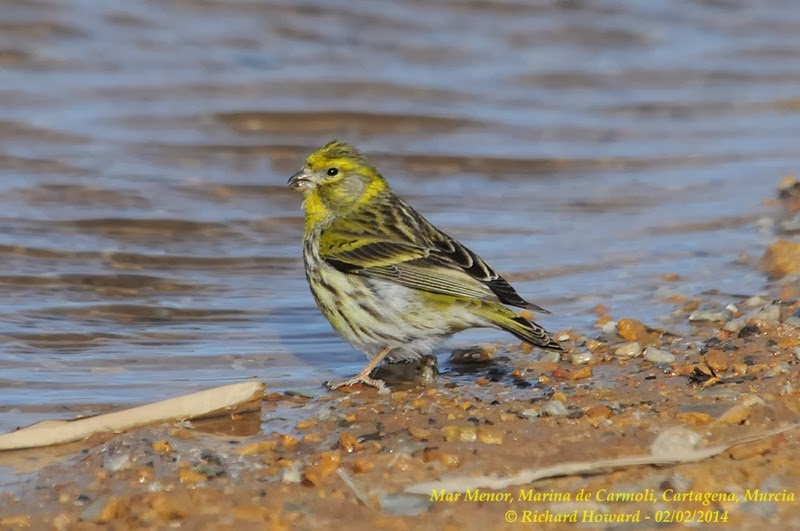
 ... male Serin ...


 ... Reed Bunting ...

 ... male Stonechat ...

 ... more Serins ...
 ... and another male Stonechat

 All the birds disappeared when this dark morph Booted Eagle came over


  but eventually they came back - here a Greenfinch ...

 
 ... and still more Serins

 And keeping an eye out over the area, a Southern Grey Shrike

I then went around to some of the farm reservoirs I know of, finding a group of 5 Ferruginous Ducks in one and had my first Swallow of the year fly over!

 The group of five Ferruginous Ducks

 And with them, a Black-necked Grebe

And that's about it for now.

Ciauu

Monday, 27 January 2014

The northwest of the Region of Murcia


Hi all,

After having to be close to home for the last couple of weekends, this last weekend (25th January 2014) I decided it was finally time to finish off my ‘birdrace’ of the 1st of January, and head for some woodlands.  Normally I would go to Sierra Espuña for my woodland birds, but as today I had no time restrictions, I decided to go further out, to the highest point in Murcia, Revolcadores, near to Caravaca de la Cruz.  But I would call in ‘en route’ at Inazares, a small village at the head of a valley where it’s quite often possible to see winter thrushes.

So, setting off at just before 8 a.m., I arrived at Inazares just before 10 a.m. (just short of a 2 hour drive to do around 180 kilometers).  The weather forecast had said that it would be a clear blue-sky day with light to moderate winds.  What do they know!!  It was overcast (at least to start with), and I would estimate the wind to have been about force 4 to 5, high up in the mountains in January, so bitterly cold – certainly not what I’m used to!  Still, after all that driving, a walk was in order (even if it was just to answer the call of nature), and I walked up the valley at the side of the village.  This is a valley that’s dry in the summer, but in wintertime, can often have at least standing water in it if not a full flowing river, and on the banks of this river are many tall poplar trees plus almond trees in small fields and bramble and rose-hip bushes.  Obviously, this is like a magnet to some birds, although today I didn’t see any Redwings, Fieldfares or Ring Ouzels.  What I did see however, were large groups of buntings, mainly Cirl Buntings, but with quite a few Rock Buntings mixed in, and eventually the bird I particularly wanted to see, Yellowhammer.  I thought I had one female in the first group of around 15 buntings I came across, but I was never 100% sure as the wind was blowing both me and the birds about, and the females can be tricky to differentiate from female Cirls.  But my next sighting was absolutely 100% - a male in breeding plumage – it almost glowed yellow!  Just what the doctor ordered.  And to add to things, there was a pair of Great Spotted Woodpeckers chasing around calling each other.  Another bird you don’t see in the coastal area of Murcia.

 Great Spotted Woodpecker that was calling and flying through the area

Just a record shot, but obvious what it is, male Yellowhammer

I left there at about 11:30 with 6 new birds for the yearlist (the three buntings, plus G.S.Woodpecker, Mistle Thrush and Great Tit!) and made my way to Cañada de la Cruz and up into the hills to Revolcadores.  Last year when I came here, I found a great location for Nuthatch, so I decided to go there and have a sandwich, and see if they were still around.  Well, I had to wait all of 5 minutes before I heard one calling, only to be joined by a second.  I spent about half an hour there trying to get photos, and then came down the hillside to another good area for birds, which has running water in water troughs for the sheep and goats, which the birds make good use of.  I spent the rest of the afternoon here just wandering around, picking up Coal Tit, Firecrest, Crested Tit, Woodlark, Crossbill, and, BLUE TIT!  Thank goodness for that – I don’t have to worry any more about where I might pick up Blue Tit.  And I heard a couple of Ring Ouzels, although I didn’t catch up with them.

 The long straight road leading to Andalucia

 In this, the highest part of the Region of Murcia, snow could be seen on the hilltops

 Principally pine woods, there are a few deciduous trees around

To the delight of many birds, many of the trees are festooned in mistletoe

 In the arable fields on the way, several Carrion Crows

 Stopping along the way for a sandwich 'brunch'...

... this Nuthatch showed itself

 Lower down in the woods, a Crested Tit ...

... together with Coal Tit ...


... and in the shadows, a pair of Firecrests showed themselves

So, back home again at 5 p.m., arriving back just under 2 hours later, a round trip of 390 km. a good day out (even if it was cold), and 14 new woodland birds for the year.

Ciauu.
 

Saturday, 25 January 2014

Salinas de Rasall, Calblanque


Hi all,

After a couple of weeks devoted to local counts for the annual International Winter Wildfowl Census (and as so often occurs when there is a census, it seems that hardly any birds were seen), last Thursday I finally found myself with a free afternoon, so decided that as I hadn’t been over to Calblanque for a while, I’d pop over there and read some colour rings on the Audouin’s gulls at the old Salinas (and also keep an eye open for Glaucous Gull, as they seem to be all over the place here in Spain – virtually ever Galicia west coast port has one or more, and they’ve reached Malaga and Cadiz in the south, and they’ve even got as far south as the southern tip of Tenerife in the Canary Islands).

For those of you that have never been there, the old salinas (or ‘salinas de Rasall’ to give them their proper title) were working salt-pans up until about 25 years ago, and over the past couple of years some money and a lot of effort has been spent on them to renovate them by rebuilding the individual lagoon walls, and building a new ‘header’ reservoir at the western end so that in the summer, whereas they used to dry out, there is now a source of water to keep them topped up.  And finally, in the last couple of months a couple of windmills have been built to pump water from the Mediterranean into the reservoir (so the next time you go over there, the two big metal structures doesn’t mean someone’s struck oil – it’s the windmills). Of course that still leaves one major problem – what to do with the seriously saline water, but I’m sure someone will come up with a (saline) solution.

 The 'salinas de Rasall' in Calblanque

The Audouins Gulls seem to love just standing on the lagoon walls...

... or sitting there, which doesn't help with ring reading

Anyway, back to the gulls.  These Salinas are a favourite place for the Audouin’s gulls to call in at as they slowly make their way further north to their main breeding areas, in the ‘La Mata’ lagoon and on the island of Benidorm (Alicante); the Balearic islands and the ‘delta del Ebro’ in Tarragona.  They rest on the walls of the lagoons during the day, and then go off fishing for squid and anything else they can find by night, so the best time to see any numbers of them is in the afternoon, even though the suns position can be problematical.  Their main spring passage period is between now and the end of March, and in some years I’ve seen more than 700 of them in the Salinas – not bad for a bird that in the 1970s was considered to be virtually on the brink of extinction.  Due to their rarity, efforts have been made to evaluate their movements, and to this end, many of the chicks are colour ringed while they’re still flightless in the nest.  And these are the rings I try to read (normally quite large compared to metal rings, invariably a white plastic ring with black letters or numbers on them).  In total I saw 117 birds on Thursday, and was able to read 10 rings, many of which I already have the details of, as I’ve read them on previous occasions. 

In amongst them was another bird that I invariably see in January, an adult Common Gull.  Quite a rarity in the region of Murcia, I can only presume that it’s a bird that has been blown off course at some stage in its life, and has joined up in a group of what would be its nearest relative, and stayed with them.


On Thursday in amongst the Audouins was this Common Gull (Larus canus) -
light conditions weren't perfect for photographs, but you can see what it is


Other birds seen at the salinas were Shelduck, Slender Billed Gulls, Flamingos, Kentish Plover, Redshanks, Spotted Redshanks, Greenshanks, Little Egrets, Grey Heron, Little Owl, Marsh Harrier, Mallard, Water Pipit, Black-headed Gull, Little Ringed Plover, Avocet, Chiffchaff, Stonechat and Crested Lark, and from the first hide overlooking the Salinas, a Water Rail was calling.

 Since the salinas have had water pumped in, the number of visiting Flamingos has gone up

 On Thursday, this Marsh Harrier flew through causing panic with the Audouins Gulls

 Another regular at this time of year, Slender-billed Gull

 And keeping an eye on the place all year round, Little Owl

If you'd like to find out more about Calblanque and the efforts to restore it, check out the 'Associación Calblanque' blog which can be accessed on the right hand column from this blog.  Their next activity is on Sunday, 9th February - for further details check with the information centre in the reserve.


Ciauu!


Tuesday, 7 January 2014

A visitor from home – Pied Wagtail!

First seen by Tomás García at the end of last year, on the afternoon of 4th January I had a couple of hours free and went with Tomás to the piles of manure near the A30 Cartagena-Murcia motorway where amongst the masses of White Wagtails (Motacilla alba alba), feeding on insects, there is a Pied Wagtail (Motacilla alba yarrellii).  Although I’m not normally too bothered about sub-species, I thought I’d go and have a look at the bird as they’re pretty rare in Murcia (in Spain in general, as would be expected, the further north, the more common they are in winter), and it didn’t seem right not to bother after it had flown so far!   Although the light wasn’t brilliant, I managed to get a few photos including one of the bird with a White Wagtail in the frame.  On my way home just before dark, I had a female Merlin cross the motorway plus a Sparrowhawk – the Merlin was my second that day prior to which I hadn’t seen one since autumn 2012!  So all in all, not a bad afternoon!


Exact location details for the wagtail can be found on the website ‘www.reservoirbirds.com’.


Pied Wagtail, the last photo a record shot also showing
the colour difference with a White Wagtail in the foreground