Monday, 24 February 2014

A day out at El Hondo


On Saturday, 22nd February, together with Mick Brewer, I went out of the region of Murcia for my first visit of the year to the ‘El Hondo’ reserve which is inland from Santa Pola in the neighbouring province of Alicante.  This has to be one of the best organised reserves in the east of Spain, although due to budget cuts, the information centre is now closed on Saturdays!  This doesn’t stop the ornithological trail from being open from 9-30 am until 12-30 (in fact it’s now ONLY open on Saturdays, and it is necessary to pre-book a visit to this trail).

Arriving at just after 9, there was already quite a queue of cars waiting to go in, and we actually went in at 9-10, heading directly for the large raised hide at the end of the trail.  From here it is possible to see two lagoons, one to the west of the hide and the other to the east. However, viewing the lagoon to the east (which invariably has the most birds on it), you are always looking into the sun and so virtually everything is in silhouette.  The light for the view to the western lagoon is perfect, but the only birds on the water there today were many Coots, and a few Little Grebes which were trilling away to form pairs.  At the edge of the reeds around the lagoon we had a couple of Great White Egrets fly over, and singing from the reeds I could hear at least two Moustached Warblers (the advantage of going to El Hondo at this time of the year is that the Reed Warblers have not arrived yet, and so the birds that sound like Reed Warblers are invariably Moustached Warblers).  They took some searching for, as they often sing from the bases of the reeds, but being in the hide which is on legs (and so about 4 metres above ground level) eventually we managed to get good views of one through the ‘scope.  In the same area of reeds I could also hear some Penduline Tits – it’s amazing how well they blend in considering their bright colours – but again with some prolonged searching we managed to see at least 3 birds.

 The Booted Eagle sat in a tree for quite a while

 View from the hide looking west.  In the reeds we had Moustached Warbler and Penduline Tits

 The raised hide at the end of the trail

We had Chiffchaffs singing all the time, and Cetti’s Warblers and Water Rails occasionally added to the sounds.  Perched in one of the dead trees we had a Booted Eagle for about 15 minutes and on an electricity pylon, a Common Buzzard perched with another flying around.  Over the reeds there always seemed to be at least one Marsh Harrier in the air, and we also had a flock of about 50 Glossy Ibises fly past, and small flock of six Common Snipe. A couple of times we had a falcon zoom by that wasn’t a Kestrel or Peregrine, which we eventually decided was a Merlin, but the highlight from that hide was seeing distantly towards the south end of the line of eucalyptus trees, two Spotted Eagles one of which was attacking the other (whether just in play or seriously we don’t know).  We saw these on and off over about 20 minutes.

At about 11-15 we left that hide, as we still had some other hides to look from, and going back to the first hide along the trail, we were lucky enough to see a third much closer Spotted Eagle, this one an adult, which was being mobbed firstly by three Grey Herons, and then later by a Marsh Harrier.  From the first hide we could see a lot of duck (mainly Teal, Shoveler, Shelduck and Mallard), a few Lapwing and a largish group of around 50 Black-tailed Godwits, a Ruff, Green Sandpiper plus some other smaller waders (probably Dunlin), but by this time of the morning the heat haze was such that it was almost impossible to see these birds clearly to identify them.  We could also see some of the Glossy Ibises there.

 Adult Spotted Eagle ...
 ... attacked first by three Grey Herons ...

 ... and then by a Marsh Harrier

View to the south, where all the waders were to be seen

Leaving the ornithological trail at 12-30, we went round to the information centre for a sandwich lunch.  Here there are picnic table set out under a shaded area, next to which is a small lagoon where there are always Moorhens, Coots, Purple Gallinules and Little Grebes, and some introduced Crested Coots.  Flying over this lagoon were good numbers of Crag and House Martins, and a few Swallows.

 At the pool by the picnic area, one of the introduced Crested Coots

From here we took a walk along the boardwalk area with views over the reedbeds, and then a look from the two ‘VOLCAM’ hides, but by this time of day things were pretty quiet (although we did have another distant view of one of the Spotted Eagles). On one of the lagoons there was nothing but Coots and Little Grebes, but on the other were good numbers of Pochard and around 15 Tufted Ducks – quite a large number for this species.


Views from the 'VOLCAM' hides

We decided to finish the day round the other (south-eastern) side of the reserve, along what is known as the ‘Vistabella Road’, but going past the rubbish tip near to the north gate, we saw a large number of gulls flying around, so we decided to investigate (we’d already been there once, but the tip wasn’t working and there didn’t seem to be any birds there at all).  From a small raised bank we could look into the tip works area where there were hundreds of gulls, mainly Black-headed but also a few Mediterranean and Yellow-legged. Also there were masses of Cattle Egrets and a few Jackdaws.

 At the rubbish tip, there were plenty of gulls - mainly Black-headed, but Mediterraneans as well ...

 ... and large numbers of Cattle Egrets

But the commonest gulls were Black-headed

Round at the south side of the reserve, we had more Marsh Harriers and Booted Eagles flying around, and we found the new hide that has been put up – and what a great hide it is!  About 150 metres into the reserve, it has panoramic views over water, reedbeds and a little bit of marshy edge.  We spent the rest of our time there just watching and waiting – here we had a large flock of gulls (Black-headed and Mediterranean) on the water, plus more Pochard, and Tufted Ducks, and some Red Crested Pochards (males and females).  We had Little Grebes trilling all the time, and a single Great Crested Grebe asleep on the lagoon, at least four Great White Egrets and a Purple Gallinule, many Cormorants on posts and the best bird from there, an Osprey which was also perched on a post all the time we were there.  And there seemed to be a flock of around 100 Glossy Ibises which just didn’t know where to settle – they must have flown over at least six times, to and fro.

 Part of the group of Glossy Ibises that kept flying around

 Marsh Harriers were with us all day long

 The Ibises did some pretty close flypasts ...
 
 ... as did this group of Cattle Egrets

 One minute one way, the next minute another ...

 ... the Ibises just couldn't make up their minds where they wanted to go

Also seen and heard all day, Little Grebes

This Osprey spent all the time we were there, on this post ...

 ... although the majority of birds on posts were Cormorants

 The hide where we spent a few hours in the afternoon

All too soon, it was time to set off for home, so after a quick look at some of the nearby fields for Common Crane (one of the few birds we DIDN’T see) it was back onto the motorway and home.

Bird species seen/heard during the day:

Little Grebe; Great Crested Grebe; Black Necked Grebe; Cormorant; Cattle Egret; Little Egret; Great White Egret; Grey Heron; Glossy Ibis; Greater Flamingo; Shelduck; Mallard; Shoveler; Teal; Red Crested Pochard; Pochard; Tufted Duck; White-headed Duck; Marsh Harrier; Common Buzzard; Golden Eagle; Spotted Eagle; Booted Eagle; Osprey; Kestrel; Merlin; Red-legged Partridge; Water Rail; Purple Gallinule; Moorhen; Coot; Crested Coot; Black Winged Stilt; Avocet; Lapwing; Ruff; CommonSnipe; Black-tailed Godwit; Redshank; Greenshank; Green Sandpiper; Mediterranean Gull; Black-headed Gull; Yellow-legged Gull; Woodpigeon; Collared Dove; Kingfisher; Hoopoe; Crested Lark; Swallow; House Martin; Crag Martin; Meadow Pipit; White Wagtail; Stonechat; Blackbird; Cetti’s Warbler; Moustached Warbler; Sardinian Warbler; Fan-tailed Warbler; Chiffchaff; Penduline Tit; Southern Grey Shrike; Magpie; Jackdaw; Spotless Starling; House Sparrow; Reed Bunting.

Saturday, 15 February 2014

A bird (or six) in the bush…..


Hi all,

On Saturday (15th February) I went back to Sierra Espuña again, this time with Mick Brewer who had never been there before, and was keen to see the birds I wrote about last week. We went straight up to the ‘pozos  de nieve de Cartagena', arriving there at around 10:15, and unlike last week, this time there was very little cloud, no wind and the temperature was a very mild 15º.  We must have been the first people to have walked to the ‘pozos’ this morning, as on the way there, we bumped into a herd of around 50 Barbary sheep (or Arruí in spanish, (Ammotragus lervia)).  These animals are normally extremely shy, but although we couldn’t approach too closely, they didn’t seem to be particularly bothered by us, just ambling off as we approached.  We saw some more later on, a more typical sighting, up on top of the rock hills.

Part of the herd of Arruí, or Barbary Sheep


 They didn't seem at all bothered by us

 
Arruí, or Barbary Sheep, as they are more typically seen
 
Walking to the ‘pozos’, things were very quiet, to the extent that I hoped we hadn’t made a mistake in coming up here. But when we arrived at the last ‘pozo’, where there is a small water spring, we soon saw that it was worthwhile.  Sitting in the shade of a couple of close bushes, we watched the wild rose bushes for at least a couple of hours.  Apart from when various groups of walkers went through, the bushed seemed to forever have groups of birds in.  Over the time we were there, we had Mistle Thrush, Ring Ouzels (I estimate about 20 this week), Black Redstart, Rock Buntings, Cirl Buntings, Linnets, Goldfinches, at least 8 Crossbills, Chaffinches, Greenfinches, Coal Tits and a single Crested Tit all dropping into the bushes over the spring at some stage.  We also had the strange sight of a Short-toed Treecreeper climbing up the broken walls of one of the ‘pozos’, looking for insects.  We also had a reasonably close group of 6 Chough fly over (and we could hear them most of the time we were there), and also heard at least one Jay – a most pleasant way to spend the morning.

Some of the birds seen during the morning
 
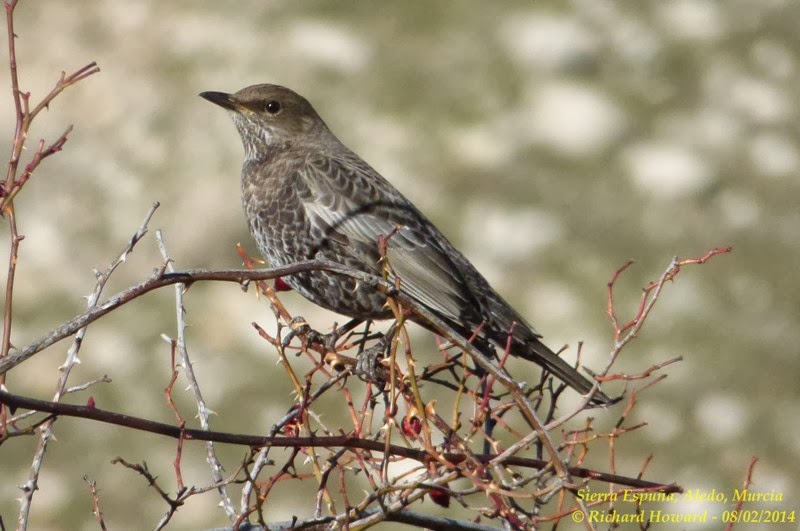
 Male Ring Ouzel

 Pair of Crossbills with male Chaffinch

 Female Cirl Bunting

 Another male Ring Ouzel

 Female Crossbill

 Female Rock Bunting

 Male Rock Bunting

 Male and female Crossbill

Leaving there just before 1pm, we went over to the other ‘pozos’ (‘pozos de la nieve de Murcia’) some of which have been repaired to show how they used to be used. Sitting in the sun, having a sandwich lunch here with the temperature a warm 19ºC, the only birds we saw of note were a pair of Ravens seen for 5 minutes or so, at one stage flying with half a dozen Choughs. In the background we had the constant song of Coal Tits (which we also had earlier at the other ‘pozos’).

 One of the restored 'pozos de la nieve'

On our way out of the reserve, coming back down from the top, we stopped at an area where the pines have recently been thinned out, leaving just small evergreen oaks.  We checked the cliffs behind these for Peregrines but didn’t see any, but DID have a couple of Firecrests and a single Short-toed Treecreeper here.

 Record shot of one of the Firecrests - it IS there, honest! Right in the centre

Our final stop on the way out of the reserve was at the recreational area of Los Alquarías, In fact we made two stops, as the recreational area was too noisy, so we finished the day stopping slightly further down towards the exit of the reserve, where we had more Crested Tits, Great Tit and Crossbills.

And that’s all for now folks, so good birding!!

Ciauu

Thursday, 13 February 2014

Sierra Espuña – Ring Ouzel country


Hi all,
 
Last Saturday (8th February) I decided it was high time to take a trip up to the nearest sierras to me, the Sierra Espuña. A mountainous area with pine forests on the lower slopes, and open meadow and rocky areas up on the top at a height of around 1500 metres. Apart from being very picturesque, my reason for going there was in the hope of seeing some of the northern thrushes, such as Redwing or Fieldfare.  I had no luck with these, and didn’t even see Mistle or Songthrush, but the lack of these was made up for by seeing good numbers of Ring Ouzels. 

Coming from Essex where you occasionally see one or maybe two on autumn passage, to see flocks of them flying around and calling to each other (and even one or two singing) is quite something.  I would estimate that over the course of the morning I saw a minimum of 30 of them, with one flock flying overhead made up of 15 birds.  These birds that come from Great Britain and presumably Scandinavia and the Alps, winter in numbers in the higher parts of Murcia (Espuña, Revolcadores) and around Nerpio (Albacete).
The zone where I see them are the ‘pozos de la nieve de Cartagena’, an open meadow area with many broken down buildings in the form of bee-hives.  This is where, in years gone by, before refrigeration and when there was a lot more snow around, the snow would be shoveled into the wells and packed down, forming ice, which would then be cut out and transported by mules to Cartagena and Murcia.  There are varios areas of ‘pozos de la nieve’, the most important being the 'pozos de la nieve de Cartagena' and 'pozos de la nieve de Murcia'.  The Murcia ‘pozos’ are off in a different direction, and one of the ‘pozos’ there has been restored back into its original state for visitors to see.

 'Sierra Espuña' as seen from the saladares del Guadalentín

 View of the top of Espuña from the entrance

 Sign explaining the Pozos

 Ruin of one of the 'pozos'

 View from the top of Espuña looking over neighbouring countryside

The 'Cartagena pozos' are in ruins, and seldom visited.  There is also there is a well here which attracts the birds, especially in a dry winter such as we are having this year.

So, setting out from Los Belones at just after 8 a.m., I arrived at the entrance to the Espuña park at just after 9-30, and then spent the next half hour slowly climbing up on the narrow hairpin mountain roads.  Parking the car, a further 20 minutes walk brought me to where I wanted to be.  Conditions entering the park, clear skies, no wind and a pleasant 12ºC; conditions on the top still mainly clear skies with quite heavy grey clouds passing rapidly over, wind about force 4 south westerly and temperature I would guess at about 4ºC!  Gloves needed!

I spent a couple of hours close to some wild rose bushes next to the well, which is where all the thirsty birds would come down and perch before dropping to the ground to have a drink.  It was quite a spectacle.  Apart from the Ring Ouzels, there were also Rock and Cirl Buntings, Crested and Coal Tits, Green, Gold and Chaffinches, and I also had an adult Golden Eagle fly over (although I saw it too late to get any decent photos).

 
  View of the well area
Some of the birds seen:

 Cirl Bunting

 Coal Tit

 Male Greenfinch
 Goldfinch

 Male Crossbill

 Rock Bunting

 Crested Tit

Male and female Crossbill


And a few photos of the commonest bird there, Ring Ouzel

At around 12-30, I decided it was time to leave as the clouds were gradually building up making it feel cold, and I still had a few places to visit, so after a quick look at the very top of the mountain for Alpine Accentors (no luck – I think the winter’s too mild), I came back down to a wooded area where I found some Short-toed Treecreepers, and more Coal and Crested Tits, and I finally left Espuña at around 3pm.


One of the Short-toed Treecreepers seen

As it was almost on the way home, I called into the Alhama de Murcia sewage farm (EDAR) in the hope of some hirundines and possibly waders and gallinule, but it was very quiet there – the only wader a single Common Snipe, and there were no hirundines or Purple Gallinules at all.

Crossing the motorway, I called into the ‘saladares del Guadalentín’, but here too was very quiet and cold, and the only birds of note were a group of 12 Magpies together and a single Dartford Warbler!

I didn’t stay there too long, so getting back to the Mar Menor earlier than I’d anticipated and it being still light (about an hour before sunset), I decided to have a look over the ‘marina de Carmolí’ for harriers going to roost. I spent an hour there seeing only four harriers, but it was well worth it – I saw three Marsh Harriers (including an adult male) and an adult female Pallid Harrier!

Record shot of the female adult Pallid Harrier

Not a bad day!!

The following morning, I joined up with the volunteers of the ‘Asociación Calblanque’ who were clearing up the old salt storage area of the ‘Salinas de Rasall’ in Calblanque.  As always there was a good number of Audouins Gulls there (I counted a minimum of 225), and in amongst them the adult Common Gull was once again present.  Other birds seen in the open Salinas area were 10 Shelduck, Mallard, Little Egret, Common Sandpiper and Yellow-legged, Slender-billed and Black-headed Gulls.

 Mixed in with the Audouin's Gulls, a single Common Gull

Part of the group of Audouin's Gulls

And that’s about all for now, so good birding!!

Ciauu