More visits to the lighthouse gardens at Cabo de Palos have
still failed to give the normal passage migrants. As at today (Tuesday 8th April) I
still have to see my first Woodchat Shrike or any type of Wheatear there (and
these are birds that are pretty obvious to see if they’re about), although I’ve
seen them in other places. And someone's turned the heat on - daytime it's definitely shorts weather now even if it does get pretty foggy at night.
On Wednesday 2nd April while taking my walk
around the gardens and cliffs there, I was accompanied for part of the walk by
a Whimbrel!

This Whimbrel accompanied me through the cliffs area
Going from there directly over to the ‘Arboretum’ in
Calblanque (to the left of the big car park after dropping down towards the
beach from the information centre) I was surprised to see a single Pied
Flycatcher – about a week before I normally see them.
In the afternoon of that day I went inland, searching for
Cuckoos. No luck with them, but in the
‘Sierra de Plata’ (northwest of Sucina) I had good numbers of Alpine and Common
Swifts, a couple of Red-rumped Swallows and a smart male Black-eared Wheatear.
The following morning (Thursday, 3rd April) in
the lighthouse gardens, there was a bit of movement after overnight rain/mud,
and I had 3 Chiffchaffs and singles of Blackcap (female), Common Redstart
(female) and my first Common Whitethroat of the year. There also seemed to be a lot of Blackbirds about.

Called the equivalent of 'lookout' in Spanish (Mirlo), it's not hard to understand why
Going round to the ‘Arboretum’ at Calblanque
again, apart from all the normal finches there (Goldfinch, Greenfinch, Serin
and Linnet), I had my first Bonelli’s Warbler of the year.
Back at the lighthouse gardens in the morning of Friday (4th
April), the female Redstart remained there and a few definite Pallid Swifts
plus some unidentified Common/Pallids went over, and I had a single
Chiff/Willow.
From there I went over to
the Salinas at Marchamalo and took a walk along the edge of the Salinas,
towards the ‘Playa Paraiso’ urbanisation.
Here there are many tamarisk bushes, a favourite with some of the
warblers (if they’re there!). Flying
over I had Swift/Pallid Swifts, House Martins and Swallows, but again not much
in the way of the smaller warblers – three Fan-tailed Warblers (Zitting
Cisticolas), six Sardinian Warblers, and singles of Chiff/Willow and Subalpine
Warbler. In the Salinas themselves were good numbers of Avocet and Black
Winged Stilts, a mixed group of 18 small waders (3 Dunlin and 15 Little Stints)
and a single Common Sandpiper. At the
‘Playa Paraiso’ end of the Salinas I saw single Little Ringed and Kentish
Plovers, both of which I think are breeding there.

Subalpine Warbler seen on the edge of the salinas at Marchamalo
Saturdays seem to
have developed into my ‘awayday’ day as I’ve got the whole day free, and with a
good day forecast weatherwise, on Saturday 5th April I set out early
for a visit to the ‘saladares del Guadalentín’, the area in the triangle
bounded by Alhama de Murcia, Totana and Mazarron. There were a number of birds I was looking
out for, many of which I hadn’t seen this year.
Arriving at the ‘saladares’ at 8-15, it was quite cloudy. I took a drive down to the river valley, along
the banks of the valley and alongside the Totana/Mazarron motorway, but the
only birds seen/heard of particular interest were Tree Sparrows and a Quail
heard calling – I’m amazed that I didn’t see any Great Spotted Cuckoos as
they’re nearly always there at this time of the year. Stopping on seeing a raptor on the other side
of the Totana/Mazarron motorway, I ‘scoped the bird and saw that it was a Black
Kite – a very good record for the area!
As it was still quite
dull and cloudy, I decided to come out of the ‘saladares’ and call in at the
‘Charcas de las Moreras’ (otherwise known as the EDAR Mazarron – Mazarron
sewage farm) which aren’t too far away.
It’s a place best seen in the morning as otherwise you can be bothered
by the sun, and it’s only 20 minutes away from the ‘saladares’ (I’ll be adding
it to my ‘locations’ list shortly).
At the ‘Charcas’
(basically two large settlement pools, one old with well established reedbeds,
the other much newer), I had numerous Pochard, Shoveler, White-headed Ducks,
Mallard, Little Grebes, Moorhens and Coots, plus a couple of Purple Gallinules (Swamphens)
in the reedbeds. Also in the reeds I
had Nightingale and Reed Warblers singing, and in surrounding bushes were
Blackcap, Chiff/Willows and Sardinian Warblers and Serins, and overhead Common
Swifts, House Martins and Red-rumped Swallows.

The main well established lake, surrounded by reedbeds ...

... and in this lake can be seen Pochard and White-headed Ducks amongst others

Another of the reed bed birds - the rear end of a Reed Warbler!


Views of the other newer lake - much more open
Returning to the ‘saladares’, things were looking much
brighter – the clouds burning off and it was a lot warmer. (I stayed till about 3-30pm when it was
positively uncomfortably HOT – around 30ºC I would guess – the first time it’s
been that hot this year). The birds were
much more active now, and driving around the area, notable birds seen included
Hoopoe, Calandra Larks, Short-toed and Lesser Short-toed Larks, Little Owl,
Lesser Kestrels, Turtle Dove (my first of the year), Cuckoo (also my first of
the year), Marsh Harrier, Green Woodpecker, 3 Woodchat Shrikes, 4 Spectacled
Warblers and 2 Black-eared Wheatears.

Back at the saladares, with more sun, the birds were starting to show - here a Lesser Short-toed Lark ...

... Woodchat Shrike ...

... Red-legged Partridge ...

... Hoopoe ...

... Calandra Lark ...

... an early Turtle Dove ...


... Lesser Kestrels ...


... and a Spectacled Warbler that was very showy
Having had enough by 3-30pm (and suffering from the heat), I
decided to call it a day here, and as I was in the area, called into the EDAR
(sewage farm) Alhama de Murcia, which is at the back of the nearby industrial
estate on the way into Alhama from the motorway. The biggest surprise there, wasn’t avian at
all, but was that the hide that used to look over almost nothing – just a load
of overgrown ground – now looked over a pristine new lagoon with two islands in
the middle of it – as it was so new there was hardly anything on it, just a few
Black Winged Stilts and a couple of Mallard, but it gives hope for the future
(if only we could get something like that for the so-called ‘wetland of El
Algar’ which has been bone dry ever since the day it was built!). The other lagoons things were very quiet with
just Coots, Moorhens and Little Grebes, and House and Sand Martins and Swallows
flying over them, so I didn’t stay too long.

The new lagoon at the EDAR Alhama de Murcia
Getting back to the Mar Menor area at around 5pm, I decided
to call in to the San Pedro Salinas for the first time this week. On the main lagoons there wasn’t much
different to be seen from previous weeks (the usual Greater Flamingos,
Shelducks, Kentish Plovers, Black Winged Stilts and Avocets) but Gull-billed
Terns were much more in evidence, flying over calling on the way out of the
Salinas to nearby ‘campos’. And as in
previous weeks, the best concentration of birds were in the perimeter canals – a
couple of female Mallards with two different aged broods of ducklings,
Redshanks, Spotted Redshanks, Common Snipe and a couple of Ruff, and Red-rumped Swallows
flying overhead.

Back at the Mar Menor, in San Javier, a Snipe in one of the farm reservoirs

At the San Pedro salinas, the normal birds - here a Little Egret ...

... group of Redshank ...

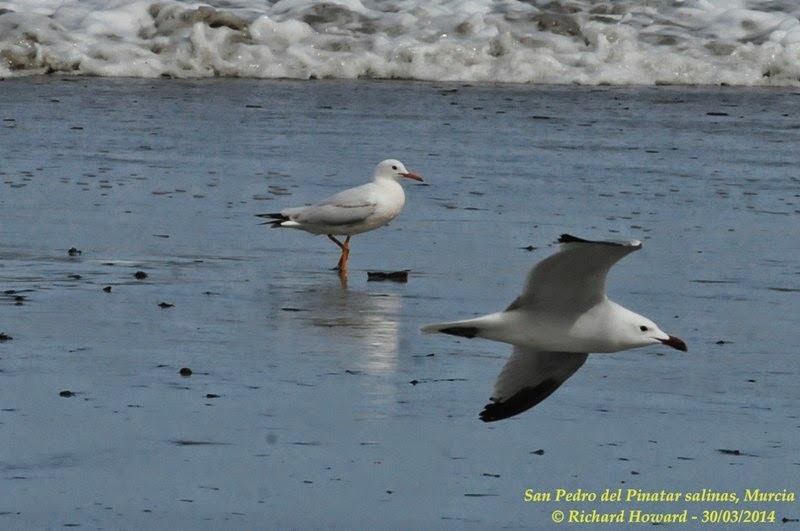
... Slender-billed Gull in breeding plumage ...

... Gull-billed Terns overhead

In the perimeter canal, a typical view ...

... but as soon as you show yourself, eveything takes flight - here two Ruff

In the main salt lagoons, plenty of Avocets
Talking of Red-rumped Swallows, there must have been quite a
movement in on Saturday, as when I eventually drove home to Los Belones via the
Mar Menor, I had groups of 30+ flying around Los Urrutias, and another 20+
around Los Nietos (quite why they should be concentrated around the ‘pueblos’ I
don’t know, as between Los Urrutias and Los Nietos I didn’t see any!).
Sunday 6th April was another hot day, so I was
just birdwatching in the morning. At the
lighthouse gardens first thing, I had a Nightingale singing from a bush in the
carpark – a good omen I thought – but in the lighthouse garden itself, again
few birds. However, going into one of
the areas nearby (which is a street with overgrown building plots on both
sides, but which can sometime turn up good birds) I had a pipit on the
ground. Checking with my bins – a Tree
Pipit! Brilliant! But getting my camera
organised the bird flew up and over some houses. I tried to follow it into
another small gardens area, but couldn’t re-locate it. Sitting on a park bench here though, I DID
have a male Common Redstart (unusually, amongst the roofs of nearby houses), a couple
of Willow/Chiffs, a definite Chiffchaff (it started singing!), 2 Robins,
Swallow, Serin, Sardinian Warbler and a Woodchat Shrike. All in the area of the size of a tennis
court!

In some small gardens areas behind the lighthouse a good mix of birds - here Woodchat Shrike ...

... and on a nearby roof, Common Redstart
On the way home I paid a quick call into the Playa Paraiso side of Marchamalo salinas, but apart from a Kentish Plover pretending not to be there, there was nothing to be seen.

At the Marchamalo salinas, a Kentish Plover pretending not to be there ...

A general view of the salinas on a hot sunny morning
Monday 7th April, instead of the lighthouse
gardens, I started the day at Calblanque, and it was a worthwhile change of
routine, as on my way over there as it was getting light, perched in one of the
Carab trees between the ‘Las Jordanas’ village and the information centre, was
a group of twelve Bee-eaters. Always
good to see, and better still when they are perched and you can really
appreciate their colours. In the
‘Arboretum’ there was nothing new, just the usual nesting finches (Greenfinch,
Goldfinch, Linnet and Serin), although one female Linnet did see intrigued to
see me and allowed close approach for some photos. The same couldn’t be said
for the nearby Woodchat Shrike I saw – avoiding me at every approach, so I had
to make do with some distant shots with the LUMIX. Apart from that, all was quiet.

It's the early birder that catches the birds - in this case a group of Bee-eaters


A Woodchat keeping an eye on things
In the afternoon I trawled around La Union and the Urrutias
end of the Mar Menor. In La Union, for
the second week running I had a pair of
Chough on one of the old mine vents (they look like wells) that are scattered
over the landscape, and on the beach at Los Urrutias by the nautical club, a
pair of Kentish Plover and the first Ringed Plovers for a while. Moving on to the ‘rambla de Albujón’ and
walking up the rambla, there were Greenshank, Common Snipe, Little Egrets,
Sardinian Warblers, Partridges, Souther Grey Shrike, White and Iberian
Wagtails, Little Ringed Plovers, a Hoopoe, Great Tit and my first Great Reed
Warblers of the year – at least two singing.
Not a bad little walk that, even if the sun gets in your eyes on the way
out.

For the second wek running, Chough in La Union

On the Mar Menor at Los Urrutias, the first Ringed Plovers for a while ...

... and a couple of Kentish Plovers

At the Rambla de Albujon, one of the Black Winged Stilts ...

... and a recently arrived Great Reed Warbler
Back at the lighthouse gardens on Tuesday (8th
April), the gardens were in thick fog when I arrived although it had burnt off
by about 9-30. The gardens were very
quiet, the only birds of note being a single female Chaffinch grubbing around
the edge of the path (I don’t think much of her chances of survival with all
the cats around), and a couple of Common Terns out in the bay between the
lighthouse and La Manga.

Arriving at the lighthouse gardens this morning, the lighthouse had disappeared!

One of the very few birds seen - a female Chaffinch ...

... while on the rocks these Common Terns waited for the fog to clear

The scene at 9-30. By 9-40, the fog had completely cleared
And that’s about it, so until my next report, happy birding!
Chauu