Pre-amble: Earlier this year I took a trip to the north of Spain, together with another five birders/naturalists from my home region of Southend in Essex. One of the group, John, had made a similar
trip last year. The main object was to
see mammals, and in particular Wolves, Bears and Wildcats. I was particularly interested in seeing the
Wildcats as I had never seen them before, and although I live in a region of
Spain where they supposedly exist, they tend to be night-time animals, and have
probably interbred with feral domestic cats.
I wanted to see the ‘real thing’ and in daylight!
Obviously, because of the places
we would be going to, there would be plenty of opportunity to see some good
birds – in particular a trip to Fuente Dé in the Picos de Europa, and a pelagic
boat trip from the northern fishing port of Gijón. It was to be a guided trip
in a mini-bus, with Karl from “Europe’s Big 5” acting as our guide and
chauffeur. The hotels we stayed at
weren´t exactly 5 star, but were perfectly adequate (although the Begoña in Gijón
being in the centre of the city was noisy).
The food (breakfast and main evening meal) was also perfectly adequate
although typically Spanish. All the hotels
had WiFi internet (to varying degrees!).
Cartagena got in – the rest of the group had come by plane from the UK
and had arrived earlier and been picked up by Karl. Then a 4 hour
(400km) dash to the Picos de Europa, staying at the Hotel Tierra
de la Reina at Boca de Huerfano, near the Embalse de Riaño on
the N-621.
Approaching the village of Boca de Huergano, the road (N-621) is
alongside the River Esla with some mountain pasture between the road
and river which must have been recently cut for hay, and here we had
two separate short sightings of Wildcat - on our first afternoon – even if
we saw nothing else, I could go back home now happy!

The pastures alongside the River Esla

The entrance to the village

The River Esla flowing through the village
Arriving at the
hotel, we unpacked and then had a little time to have a look around locally. At the back of the hotel was a river, and in
front, cultivated fields and then mountains.
We then went for an evening excursion in search of Wolves, in 4x4’s
provided by the company Wildwatching Spain
(www.wildwatchingspain.com).
After a few km. Along the N-621, we cut into a mountain track, and after
another km. or so had to dismount the 4x4’s and walk a last short although
hilly grass track. Stopping at a
viewpoint, across a valley with our ‘scopes, we saw a male and female Wolf, and two cubs which appeared to be
playing. We spent about an hour here
watching them – distantly but well – until the light began to go and it was
time to return to the hotel.
Birds and Mammals seen on the 15th
August (on the road from Madrid to Boca de Huergano and in Boca de Huergano
itself)
Common Buzzard;
Honey Buzzard; Grey Heron; Carrion Crow; Raven; Greenfinch; Goldfinch; Linnet;
Serin; Chaffinch (heard); White Wagtail; Griffon Vulture; Wren (heard); Jay;
Crag Martin; House Martin; Kestrel; Woodpigeon; Mistle Thrush; Collared Dove;
Black Redstart; Grey Wagtail; Swallow; Red-rumped Swallow; Red Kite.
Wildcat; Wolf
16th August We stayed in the Boca de Huergano area all day.
At first light, the rest of the group went on a trip to see Wolves again, but I stayed birdwatching around the hotel and was
rewarded with Dipper in the river.


The Dipper found in the river

Another of the river birds, Grey Wagtail
The
rest of the crew drove out for a few kilometres and then had an hour's walk up
hill in a beautiful scenic but hilly area where a Wolf was seen plus 6 Red
Deer stags and a Roe Deer.
Arriving back at the hotel late morning where we met up, we spent the rest of the day checking out the
area around the hotel, finding Red-backed
Shrike and Wryneck and then the
nearby Riaño reservoir and the Valle de Valdeón returning to the hotel
in the late afternoon. In the early evening we again drove by the riverside
pastures in a concerted effort for Wildcats - we saw 3 Wildcats, but this time relatively closely and at our leisure, as
they didn´t disappear as soon as we got out of the mini-bus!

Female Red-backed Shrike that was bringing up a single chick on her own

Marsh Tit

The crew at lunch at the National Park

The Picos de Europa National Park


The ´Piedrashitas´lookout

One of three Wildcats seen during the afternoon
Birds and Mammals seen on the 16th
August (around Boca de Huergano, the Riaño reservoir and the Valdeón valley)
Black
Redstart; House Martin; Swallow; Great Spotted Woodpecker; Serin; Grey Wagtail;
Dipper; Red-rumped Swallow; Blue Tit; Jay; Linnet; Common Buzzard; Blackcap;
Mistle Thrush; Grey Heron; Robin; Wren; Dunnock; Common Whitethroat;
Chiffchaff; Wryneck; Tree Pipit; Red-backed Shrike; Raven; Griffon Vulture;
Nuthatch; Coal Tit; Pied Flycatcher; Cormorant; Marsh Tit.
Wildcat; Wolf.
17th August Packing up in the Boca de Huergano area, we had an early morning trip to the valleys
around the Riaño Reservoir where we
had Fox and both Iberian Ibex and 'Cantabrian'
Chamois.

View across the Riaño Reservoir
Andrew and Karl however
decided to look for the wolf family we saw on the 15th instead but
unfortunately drew a blank but did have a good view of a Wildcat. After breakfast we made an 80km dash on the N-621 and
CA-185 to Fuente Dé, stopping en
route at Potes to refurbish supplies
(and having a group of 100 or so Red-billed
Chough in a field, and an adult Egyptian
Vulture fly overhead).

Adult Egyptian Vulture over Potes
At Fuente
Dé at around midday we took the famous cable-car to the mountain top to
search for Wallcreeper, Snowfinch, Rock
Thrush, Alpine Accentor, Alpine Chough, Lammergeier. On a cloudy day, we didn’t have much luck
with the birds – I lagged behind and struck it lucky seeing a single Wallcreeper flying around the Cable-car
station which the others didn’t get, and of the other specialities we only saw Alpine Chough and Alpine Accentor.

Our transport up the mountain at Fuente Dé

From the top cablecar station, the view back down to the base station with Griffon Vulture drifting by


Fuente Dé views

One of the birds we wanted to see, Alpine Chough ...


... and another, Alpine Accentor
Coming back
down with the cloud dropping, we made our way to the fishing port of Gijón, which was to be our base for the
night, staying in
the centre of Gijón itself, in the
hotel Begoña Centro.
Birds and Mammals seen on the 17th
August (around Boca de Huergano, the Riaño reservoir, en route to Fuente Dé and
Fuente Dé itself)
Red-billed
Chough; Egyptian Vulture; Wallcreeper; Alpine Accentor; Alpine Chough; Black
Redstart; Linnet; Peregrine; Griffon Vulture.
Ibex; Chamois;
Fox.
18th August An early morning start to get to the
harbour for 8am for the pelagic boat trip
into the Bay of Biscay - but there were no crew until 9am! Ah well, this is Spain! Eventually a 7 hour trip from Gijón harbour, on a catamaran, so very
stable, on a fairly windless day.
However by the end of it we all thought it had been worthwhile with both
birds and mammals - for me the star sightings of the day were a couple of adult
Sabine´s Gulls still in breeding
plumage.

Our transport for the day, the catamaran ´Cabopeñas´

The city of Gijón from the sea
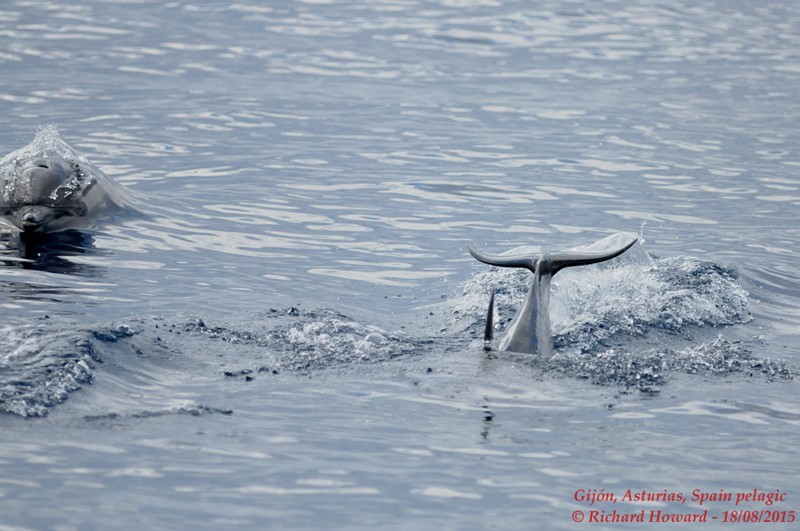
Common Dolphins alongside the catamaran

Adult Lesser Black-backed Gull

Sandwich Tern

Common Tern

Storm Petrel

Adult Black Tern

Storm Petrel


Adult Sabine´s Gull

Juvenile Gannet

Cory´s Shearwater

Diving Gannet


The second adult Sabine´s Gull

Cory´s Shearwater

Arctic Skua

Adult Gannet

Balearic Shearwater

Arctic Skua

Adult Gannet
Late afternoon
we travelled on to Somiedo National Park, to spend our next couple of nights at the Hotel Castillo de Alba in Pola de Somiedo. We quickly dumped our bags and were off again
in the van heading for a bear watchpoint at La Peral. We had to drive past another bear watchpoint
en route and on seeing that there were a lot of animated people with ´scopes we
stopped for a look – and had our first bears, mother and cub. Also while there,
we had Goshawk and Griffon Vulture. The watchpoint is on the AS-227, at the Llamardal turn-off.

Cantabrian Brown Bears, mother and cub
Birds and Mammals seen on the 18th
August (pelagic from Gijón 20 nautical miles into the Bay of Biscay, and later en
route to Pola de Somiedo)
Yellow-legged
Gull; Great Black Backed Gull; Whimbrel; Common Sandpiper; Turnstone; Manx
Shearwater; Cory’s Shearwater; Gannet; Common Tern; Lesser Black-backed Gull;
Herring Gull; Sabine’s Gull; Storm Petrel; Arctic Skua; Balearic Shearwater;
Goshawk; Griffon Vulture.
Common Dolphin;
Bottle Nosed Dolphin; Fin Whale; Cantabrian Brown Bear.
19th August An early morning trip to La Peral in the Somiedo park to search
for more Cantabrian Bears, but the
only mammals we got to see were more Chamois
in the mountains, although one of our group Bob had a
brief view of a Pine Marten. However
we did have a good variety of birds while waiting at our watchpoint, such as Griffon Vulture, male Blue Rock
Thrush, male Bullfinch, Garden
Warbler, Black Redstart, Red-backed Shrike, Tree Pipit, Pied Flycatcher and
Alpine Chough.


Views around the Lagos de Saliencia

Griffon Vulture overhead
We spent the most of the rest of the day at
the Lagos de Saliencia, an area of
outstanding beauty about forty minutes from Pola de Somiedo, where there were some very interesting butterflies,
and in the evening returned to the previous evenings bear watchpoint where we
had good views of a Golden Eagle,
but bad weather - low cloud - brought an end to that without any bear sightings.
Birds and Mammals seen on the 19th August (Somiedo National
Park)
Griffon Vulture; Golden Eagle; Blue
Rock Thrush; Bullfinch; Stonechat; Linnet; Garden Warbler; Black Redstart;
Red-backed Shrike; Tree Pipit; Jay; Alpine Chough; Pied Flycatcher.
Chamois.
20th August Another early morning trip to La Peral to look for Cantabrian Bear, but again drew a
blank, the only mammal seen being a Stoat! We did however do better with birds of prey,
with around 20 Griffon Vultures, a Short-toed Eagle and male Montagu’s Harrier and a Honey Buzzard.


Views from El Peral
After
breakfast some of the group went off for a long walk on the hills at Llamardal,
but Paul Baker and I decided to stay in Pola de Somiedo, and sitting by the
river outside a bar, we had a Sparrowhawk
take a Sparrow just above our heads!
Other birds were Griffon Vultures,
Common Buzzards and a Grey Wagtail.

Our hotel at Pola de Somiedo


Some views of Pola de Somiedo
In the afternoon
we moved on to the Municipality of Cangas
del Narcea (89km, AS-15 and AS-227,
approx 1 ½ hours), and to the Hotel
Grabelon, in Gedrez. Here we
went on to another well known watchpoint, at Fondosdevega, in Degaña (the
AS-15 between km. 87 and 88) where
apart from Chamois and a mother Cantabrian Brown Bear and its cub, there was
a variety of woodland birds.
Birds and Mammals seen on the 20th August (Somiedo National
Park) and Fondosdevega, Degaña
Griffon Vulture; Short-toed
Eagle; Montagu´s Harrier; Common and Honey Buzzards; House Martin; Sparrowhawk;
Grey Wagtail; Spanish Sparrow; Firecrest; Tree Pipit; Crested Tit (heard); Blue
Tit; Robin
Stoat; Cantabrian Brown Bear;
Chamois
21st August A morning excursion back to the Fondosdevega watchpoint for Cantabrian Bears drew a blank, although
the sighting of a Pine Martin proved
popular, and Chamois were seen on
the distant peaks. The middle of the day
was spent in the region of the Reserva Natural
Integral de Muniellos (the largest Oak forest in western Europe) and the Puerto de Conio where with clear skies
and no wind, the most interesting living things were butterflies which included
Great Banded Grayling, a male Lesser Purple Emperor and several Wall.

Iberian Emerald Lizard also known as Schreiber's Green Lizard

Great Banded Grayling

Chamois

The Muniellos Reserve

Lesser Purple Emperor butterfly

Beehives surrounded by thick wall to keep the Bears at bay
In the evening we all took the long walk to
another supposed Bear watchpoint, at the Monesterio
de Hermo, which produced no bears, but we did see more Chamois and our only Wild
Boar of the week. We stayed overnight again at the Hotel Grabelon in Gedrez where
a few beers and wines were downed on this, our last evening of the trip.
Birds and Mammals seen on the 21st August (Fondosdevega,
Muniellos, Monesterio de Hermo)
Common Buzzard; Jay; Coal Tit;
Firecrest; Grey Wagtail; Dipper; Tawny Owl (heard); Nuthatch; Pied Flycatcher; Bonellis
Warbler (heard)
Pine Martin; Chamois; Wild Boar
22nd AugustTaking our leave of the excellent Hotel Grabelon, we stopped off one
last time at the bear watchpoint at Fondosdevega,
where we had final good views of the
mother and cub Cantabrian Brown Bears we
had seen the previous day.

Cantabrian Brown Bear at Fondosdevega
From here we tore back south to Madrid airport,
stopping off briefly to watch 17 Great
Bustards and for a sandwich lunch at the Villafafila reserve, where being more meridional, we had some bird species
that we hadn’t seen all week. The
watching concluded with us having an Iberian
Magpie fly across the motorway in front of us as we approached the airport.

Great Bustards at Villafafila
Birds and Mammals seen on the 22nd August (Fondosdevega,
Villafafila, Madrid)
Great Bustard;
Short-toed Eagle; Southern Grey Shrike; Northern Wheatear; Spotless Starling;
Iberian Magpie; Common Buzzard; Woodchat Shrike.


