Thursday, 18 August 2016

Butterflies in S. E. Essex


At the beginning of the year, realising that for personal reasons I was going to have to spend the major part of the year in the UK, and knowing how the birding drops off in the summer, I decided to set myself a challenge.  Living in the south east of Essex, I have been a long-time member of SOG (the Southend Ornithological Group, www.sognet.org.uk), which apart from reporting on local birds, also reports on all other wildlife.  Looking up on the SOG website, I could see there are up to 30 regularly occurring species of butterfly.  Normally on my short visits back to see friends and family, I am never around for long enough or in the right part of the season to see many of them, but this year was different, so I started planning where and when.  This is a résumé of how I got on.

Although many of the butterflies can be seen on an ‘ad hoc’ basis around the local reserves, there are a number of species that you have to plan for due to timing or location, the first of which being the Green Hairstreak (Callophrys rubi).  This species can only be found locally in a couple of places, Benfleet/Hadleigh Downs and the Canvey Wick Bug Reserve on Canvey Island (where it may have been accidentally or purposely re-introduced), and is never common.  The time to look for them is towards the end of April although this year, due to the mild winter and then cold spring, insect life activity was about 10 days to 2 weeks behind the normal.   I had my first sighting of four insects, on a sunny warm afternoon on the 8th May with two further sightings on the 9th (another 4) and 16th May (2 seen), and that was it!

By that time my species sightings list was up to 13, having had my first butterflies on the 31st March at Vange Marsh (Small Tortoiseshell (Aglais urticae), Peacock(Inachis io)) and at Wat Tyler CP (Pitsea) (Brimstone(Gonepteryx rhamni)).  On the 3rd April I had my first butterfly in the garden, a Large White (Pieris brassicae) which flew through, and on the 8th April, my first Small Whites (Pieris rapae) (2 insects). My next new insects were on the 14th April when at Canvey Wick Bug Reserve, I had Orangetip (Anthocharis cardamines), Commas (Polygonia c-album) and Speckled Woods (Pararge aegeria).  On the 20th April on the west end of Two Tree Island I had my first Green-veined White (Piers napi).  On the 8th May, as previously mentioned, on a warm, sunny windless afternoon at the east end of the Canvey Wick Bug Reserve, I had my first Green Hairstreaks, but also that afternoon I had a couple of Small Coppers (Lycaena phlaeas), Walls (Lasiommata megera) and at least 2 Brown Argus (Aricia agestis).

Benfleet Downs on the 13th May gave me my first Holly Blues (Celastrina argiolus) (eight of them), and continuing the blue vein, my first Common Blues (Polyommatus icarus) were at the Gunners Park (Shoeburyness) butterfly transect on the 19th May.

I finally got to grips with one that I would have expected to see much earlier, on the 20th May with my first Red Admiral (Vanessa atalanta) of the year at Vange Marsh RSPB, which was also the location of my next insect, an unexpected but very welcome Clouded Yellow (Colias croceus) beating along the hedgerow parallel to the railway line.  Now with things (theoretically) warming up, a walk on the 23rd May around Bowers Marsh gave me my first Small Heath (Coenonympha pamphilus), and another walk around Gunners Park on the 4th June gave me apart from good numbers of Large Whites, Small Whites, Holly Blues and Small Heaths, my first (3) Painted Ladies (Vanessa cardui) of the year.

The end of May / beginning of June is when you should be thinking of the next targeted species, and with this in mind I checked out some local areas for Heath Fritillary (Melitae athalia) (sorry, I can’t give specific locations for this species), and finally on the afternoon of the 9th June on a sunny, warm afternoon I was rewarded with seeing 6 of these beautiful butterflies.

A walk in the afternoon of the 19th June over to Benfleet Downs gave me my first (3) Large Skippers (Ochlodes venata), and similarly a walk on the 23rd June around Bowers Marsh RSPB my first (5) Meadow Browns (Maniola jurtina).  Another visit to Benfleet Downs on the 27th June gave me Essex Skipper (Thymelicus lineola) and Ringlet (Aphantopus hyperantus) and a stroll through Belfairs NR on the 30th June my first (3) White Admirals (Limenitis Camilla).  Continuing the walk through to the Belfairs  Park centre added (4) Small Skippers (Thymelicus sylvestris) and (4) Marbled Whites (Melanargia galathea), and my species total at the end of the first 6 months of the year stood at 27.

Now more species to target, and possibly the most difficult ones of all – White-letter and Purple Hairstreaks.  I had the locations where they should occur, but would I actually get to see them?  Well, as it happened I shouldn’t have worried, as on the 4th July walking through Belfairs Woods NR I had my first Purple Hairstreak (Neozephyrus quercus) (and I even managed to get a record photo of it), and the following day on Benfleet Downs, 5 White-letter Hairstreak (Satyrium w-album).  And finally on the 7th at Bowers Marsh RSPB reserve, number 30, with a couple of Gatekeepers (Pyronia tithonus).

From here on, any additional butterflies would have to be vagrants to the area (as happened on the 19th July in Belfairs Woods when a Silver-washed Fritillary was well seen – I happened to be out of the area at the time!).

Part of my remit to myself was to not only see, but also photograph all the butterflies I saw, and to this end I managed to photograph all of the species.  On continuation, photographs of the 30 butterflies (although not necessarily of the first ones I saw).

Finally, just a note to thank all the members of SOG who helped and in some cases ‘queued up’ the butterflies for me.

 Peacock (Inachis io)
 
 Comma (Polygonia c-album)
 
 Small Tortoiseshell (Aglais urticae)
 
 Small White (Pieris rapae)
 
 Green Hairstreak (Callophrys rubi)
 
 Brown Argus (Aricia agestis)
 
 Green-veined White (Pieris napi)
 
 Holly Blue (Celastrina argiolus)
 
 Brown Argus (Aricia agestis)
 
 Common Blue (Polyommatus icarus)
 
 Common Blue (Polyommatus icarus)

 Small Copper (Lycaena phlaeas)
 
 Orange-tip (Anthocharis cardamines)
 
 Wall (Lasiommata megera)
 
 Speckled Wood (Pararge aegeria)
 
 Brown Argus (Aricia agestis)
 
 Large White (Pieris brassicae)
 
 Painted Lady (Vanessa cardui)
 
 Small Heath (Coenonympha pamphilus)
 
 Heath Fritillary (Melitaea athalia)
 
 Large Skipper Ochlodes venata)
 
 Meadow Brown (Maniola jurtina)
 
 Essex Skipper (Thymelicus lineola)
 
 Ringlet (Aphantopus hyperantus)
 
 Small Skipper (Thymelicus sylvestris)
 
 Marbled White (Melanargia galathea)
 
 Purple Hairstreak (Neozephyrus quercus)
 
 White Admiral (Limenitis camilla)
 

 White-letter Hairstreak (Satyrium w-album)
 
 Red Admiral (Vanessa atalanta)
 
 White Admiral (Limenitis camilla)
 
 Marbled White (Melanargia galathea)
 
Brimstone (Gonepteryx rhamni)

Clouded Yellow (Colias croceus)

Monday, 7 March 2016

A day outside the Parish – Passport Required!


(Chronicle of an unusual days birding)


It all started with a message in our local group’s WhatsApp group last Wednesday – one of the group was going to Holland to photograph the Siberian Rubythroat that has been there since the 15th of January, and there was a seat available should anyone be interested. 


Locally, things have been very quiet over the last few days – nothing since the Bewick’s Swans on Wallasea Island, and I’d be returning to Spain the following week, so although a ‘EuroTwitch’ isn’t normally my sort of thing, I got to thinking about it.


Siberian Rubythroat – always considered the pinnacle of birding when I was younger, with few records in the UK, the majority of which have been on the northern isles (Shetlands, Fair Isle) and extremely few on the mainland (only two I think), and hardly ever twitchable.  I would love to see one, but to do so, would have to go to Asia or Siberia (no plans at present to do so!), or possibly spend a month on Shetland or Fair Isle in the autumn (again, no plans to do so, and would be very expensive).


Or, jump in someone else's car, be chauffeur driven to the site, see the bird and come back again, all within a day.


As you can tell, I didn’t take much persuading!


So, Friday evening at 9:15 saw me being collected from home by Steve Arlow of our local group (SOG – Southend Ornithological Group - http://www.sognet.org.uk). We then met up with Brett Spencer and Richard Bonser (who was to be our driver for the trip), and caught the first Channel Tunnel train just after midnight to Calais (which in itself was a new experience for me).


On a cold but dry night with various stops, we got to the site of the Rubythroat (Hoogwoud) just before eight in the morning (local time), parking just around the corner from where it has been seen.  As there was only a slight slither of light on the horizon, both Rich and I decided to make the most of being stopped, and take a half-hour’s nap in the car.  Steve and Brett went out to survey the site, but within 5 minutes were back at the car – the Rubythroat was showing!


I should perhaps point out here that we had been told that normally it has been seen for 5 minutes, then disappearing for about a half hour before returning to the same area.  Also, the weather forecast for the day was not particularly good – overcast (with possibility of snow) to begin, clearing after midday.  So knowing that it was out and about already, it HAD to be seen while we knew it was there!  So, that was our power-sleep out of the window!


And so much for its habits – apart from 2 periods of about 20 minutes when it disappeared, once with a Robin and the other time chased off by a Blackbird, it hung around the same area all the time!  And apart from the area being in shadow to start with, it was pretty much a sunny morning all morning.  The four of us (and all the other Dutch birders who passed by) had SUPERB views of the bird, with it coming out into the open down to less than a metre (too close for some of the big lens's to focus), and for a period of just under 10 minutes, we had it in a bush singing! Sufficient for me to say that even the photographers Steve and Rich, who specifically wanted to see the bird to photograph it, had seen enough by about 11:30, and so we decided to go off and see if we could find some other birds.  Both Steve and Rich, who have both seen Rubythroats in the UK and abroad before, said it was the best sighting they´d ever had.


Rich had all the details of another bird on his WP birds wishlist, which we gave ourselves five minutes to find and watch – Alexandrine Parakeet in a park in the centre of Amsterdam.  Once we’d found the park (Oosterpark) and had parked up, it DID only take about 5 minutes.  The park is full of Rose-ringed Parakeets, but also has a self-sustaining population of these Alexandrine Parakeets which look very similar to the Rose-ringed, but are larger with a much chunkier bill.


So within 15 minutes of arriving at the park, we were back on the road again.


As part of my preparation for the trip, I had printed out map locations of various other birds that I thought we may have found of interest, and we decided to go for one of them, about halfway back towards Calais (i.e. on our way home), at a coastal site called Wilhelminadorp, where a female Pine Bunting has taken up winter residence and has been seen since the 18th December 2015.  Arriving at the location at around two in the afternoon, we were lucky enough to bump into a birder who could give us the exact location, and after some 15 minutes scrutinizing the area, we had the bird.  It was acting like a mouse, running around the upper high tide limit where a lot of broken canes had floated, and appeared to be eating the canes in order to get to any insects that had taken up residence in the stems.  It was another bird that seemed very confident in the presence of humans, being photographed at down to just over a metre, and again in all the time we watched it, it only disappeared into the grassy area out of view a couple of times for a few minutes.  Eventually, we lost the sun behind a large grey cloud and the bird flew off giving a single metallic call as it flew, (nothing like a Yellowhammer’s).  It flew over the seawall to the area where we were parked, but we couldn’t get back on it, so decided to call it a day – excellent views of two very smart birds, plus the parakeet in between!


And our luck remained with us as the weather now turned nasty as we headed back to Calais.  When we got there, we were far too early for our booked train, but were allowed to catch the one one-and-a-half hours before our scheduled train for no extra charge (and in actual fact, by mistake we caught an earlier one still), so I was back home at just after 9:35 pm – just over 24 hours – and at a total cost of £50!


So my thanks to my companions, Steve, Brett and especially Rich for the driving and the use of his car, and for an excellent days birding which I will remember for a long, long time to come!

The photos:

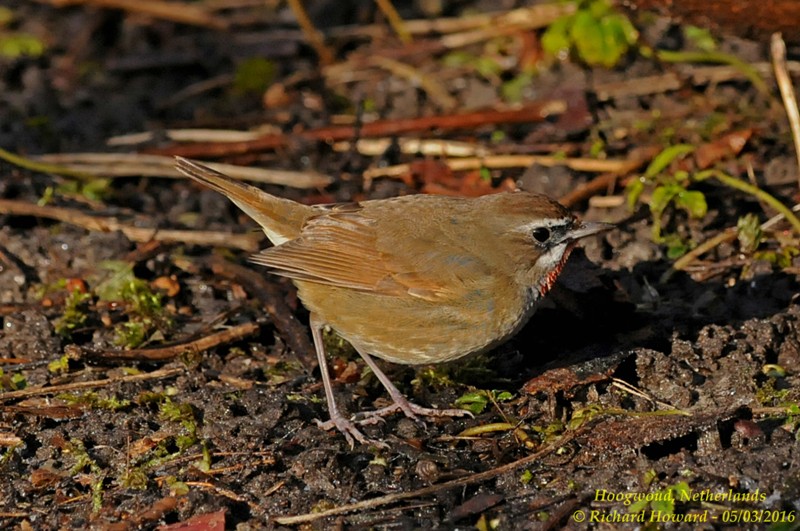
Siberian Rubythroat (Calliope calliope) - Hoogwoud, Netherlands


 Alexandrine Parakeet - Oosterpark, Amsterdam, Netherlands


Pine Bunting - Wilhelminadorp, Netherlands


The videos:


Tuesday, 23 February 2016

Recent visits to El Hondo - Alicante Province

Between my Christmas and New Year visit to the UK and my current one, while back in Murcia I had a few free afternoons and went up to the El Hondo reserve, near to Crevillente in the neighbouring province of Alicante.  the dates of my visits were the 4th, 6th and 9th of February.  In particular I wanted to the the Sociable Plover that has been seen on and off throughout the winter.

4th February 2016

I started on the 4th from the Information Centre, where in the pond backing onto the centre, I had 4 Purple Gallinules and a bit of a surprise, 6 neck-ringed Crested Coots (the surprise being that on my last visit there, there had been none of the original ringed birds left from the first time they were introduced there.  Obviously another introduction attempt!


Purple Gallinules and Crested Coots in the 'pond' behind the Information Centre

In the new pools around the Information Centre were a couple of White-headed Ducks, masses of Chiffchaffs and a few Bluethroats calling.  While I was scanning over the reedbeds from the slightly raised viewpoint, a pale morph Booted Eagle stooped don onto a couple of Purple Gallinules but without success - maybe me being there had put it off, but it certainly made all the other waterbirds (Coots, Moorhens, Little Grebes, Little Egrets, Grey Herons, Snipe) edgy!

 Booted Eagle flying off after its unsuccessful attack on the Purple Gallinules

Coot and Purple Gallinule

 Pair of Purple Gallinules, after the attack by the Booted Eagle

Continuing on to the 'new' hides (VOLCAM hide and the one opposite), there wasn't a lot to see in the lagoons, but continuing on to where all the waders normally congregate, I had 14 Glossy Ibis, 39 Little Stints, Wood Sandpiper, Ringed, Little Ringed and Kentish Plovers,Dunlin, Black Winged Stilts and Green Sandpipers.


 Part of the group of Glossy Ibis's

Moving on to the Vistabella road, I had more Booted Eagles and a LOT of sightings of Marsh Harriers, a flock of 25 Stone Curlews fly over and another flock of 25 Black-tailed Godwits also fly over, and there were over 100 Crag Martins on the wing.  Waiting until dusk, in a field I had a group of 36 Lapwings, but no sign of the Sociable Plover.  That would obviously have to wait another day!

Bird Species seen during the visit:

Great Crested Grebe; Little Grebe; Black Necked Grebe; Little Egret; Cattle Egret; Grey Heron; Glossy Ibis; Cormorant; Marsh Harrier; Booted Eagle; Shelduck; Mallard; White-headed Duck; Stone Curlew; Black Winged Stilt; Lapwing; Dunlin, Little Stint; Green Sandpiper; Wood Sandpiper; Common Snipe; Ringed Plover; Little Ringed Plover; Kentish Plover; Black-tailed Godwit; Coot; Crested Coot; Moorhen; Purple Gallinule (Swamphen); Kingfisher; Grey Wagtail; White Wagtail; Southern Grey Shrike; Cettis Warbler, Chiffchaff; Bluethroat, Black Redstart; Stonechat; Magpie; Reed Bunting.
   
6th February 2016

My second visit was with Tomás Garcia, after an afternoon call in at Guardamar harbour  (where we had Common Scoters, Razorbill, Gannets, Grey Wagtail, Sandwich Terns and Kingfisher).  This visit, we did not call into the Information Centre area, but just kept searching the fields south of the Vistabella road.  This was quite productive as we had Common Buzzards, a ringtail Hen Harrier, at least 8 Marsh Harriers, 3 Booted Eagles, and a distant group of 30+ Glossy Ibis's.  We also stumbled across the Black-shouldered Kite that has been wintering there, flushed a Squacco Heron from just by the reserve South Gate, and in amongst a group of 20+ Skylarks in a field, came across a female Cirl Bunting.  Once again at dusk, we came across a group of 60+ Lapwings, but no Sociable Plover.


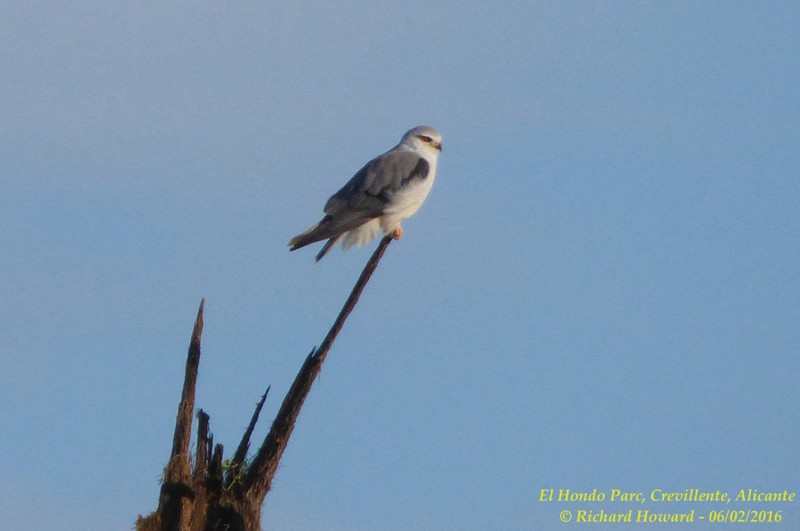
 The Black Shouldered Kite we stumbled across

Bird Species seen during the visit:

Great Crested Grebe; Little Grebe; Black Necked Grebe; Little Egret; Cattle Egret; Squacco Heron; Grey Heron; Glossy Ibis; Cormorant; Marsh Harrier; Hen Harrier; Booted Eagle; Black-shouldered Kite; Shelduck; Mallard; Pochard; White-headed Duck; Lapwing; Green Sandpiper; Kingfisher; Skylark; White Wagtail; Southern Grey Shrike; Cettis Warbler, Chiffchaff; Bluethroat, Black Redstart; Stonechat; Magpie; Reed Bunting, Cirl Bunting; Corn Bunting.

9th February 2016

An unscheduled visit this, once again with Tomás Garcia.  I had a call from a friend in Alicante to say that a group of three Barnacle Geese had been seen recently at the Santa Pola salinas, and that he himself had seen them that morning.  A quick call to Tomás and he was game, so we both shot up there.  On the journey, more information came out - the geese were distant, hard to see, and there was a possibility that they weren´t pure Barnacles, but Barnacle x Bar-headed Geese!  And possibly the three that had been seen up until the previous Friday at the Albufura in Valencia. So when after about half an hour not seeing the geese a call into El Hondo was mooted, I was all for it.  Especially as we had met up with Oscar Aldeguer and Jana Marco, local to El Hondo and who know the place like the backs of their hands.

Again we concentrated on the fields to the south of El Hondo, south of the Vistabella road.  And this time we struck lucky.  Starting with a male Merlin shooting over some fields, we then had the Black Shouldered Kite again, and a male Hen Harrier going through another field.  And then quite early (it was by then only about 5:30), we saw the large flock of Lapwings, and more importantly, saw where they dropped.  We found a track which took us to a safe distance from where they were, and then scanning through them, there was the Sociable Plover!  Very smart as it's now beginning to come into breeding plumage.  Third time lucky (again).  We spent about an hour in total watching this bird (which wasn't easy, as the flock kept moving and was in a field with a 'hedgerow' of short bushes), and attached is a link to a short video I took.

 Cattle Egrets, doing what they do

 Still in the same place hunting, the Black Shouldered Kite


And the icing on the cake - while there, on looking around behind us, a flock of about 40 Cranes dropped in (the light was now dropping).  We decided to go and try to find the Cranes, but couldn't locate them, and now almost dark we decided to give up for the day.

And the cherry on the icing on the cake - saying our good-byes, a Night Heron flew over us... then another... then another - until in total 10 had flown over where we were standing (and Oscar and Jana stayed to see if any more would pass over).

All in all, quite a successful trio of visits, with just the Spotted Eagles outstanding.  Watch this space..............
 

Bird Species seen during the visit:

Little Egret; Cattle Egret; Night Heron; Grey Heron; Cormorant; Marsh Harrier; Hen Harrier; Booted Eagle; Common Crane; Black-shouldered Kite; Merlin; Lapwing; Sociable Plover; Golden Plover; Green Sandpiper; Skylark; White Wagtail; Southern Grey Shrike; Cettis Warbler, Chiffchaff; Black Redstart; Stonechat; Magpie; Corn Bunting.