Showing posts with label Tarifa. Show all posts

Thursday, 2 October 2014

A weekend in Tarifa


To the world at large, Tarifa is known for watersports such as windsurf and kite-surf, and in fact at the entrance to the town, there is a sign saying ‘Costa Azul – Costa de Windsurf’.  But within the birdwatching fraternity it is known for a totally different reason – watching the large soaring birds as they make their way to and from Africa, and birdwatchers from all over Europe go there to watch this spectacle.  Raptors and Storks generally don’t like to cross over large expanses of water, and to tend to use this southernmost part of Spain to cross to or from Africa – from Tarifa, the coast of Morocco is easily visible, being only 16 kilometres away.

The last Friday in September is a local ‘fiesta’ for the Cartagena area, and as is quite often the case in this particular weekend, the weather forecast was for heavy rain for the Region of Murcia. A good reason to get away, and what better place than down to Tarifa.  So last weekend together with my sister, I headed southwest.  Tarifa isn’t exactly ‘just around the corner’ (as the crow flies, it is 455 km away), and due to the route we took, it took us around 10 hours to get there – mind you that was with various stops en-route, and we checked into our pre-booked hostel at around 5pm., and were back out in the field by 5-30.

Just as in the UK where more southerly bird species that have gradually become breeders (such as Little Egret, Spoonbill, Great White Egret), in Spain there are also new species, one of which is the Common Bulbul (Pycnonotus barbatus).  After an initial sighting in April 2013, Tarifa has had a pair breed for the last two years in the immediate vicinity.  I had looked for the species on my two previous visits without success, but this time, with the help of www.reservoirbirds.com, I hoped I had a good idea to where they might be found.  Not a spectacular bird, being basically grey-brown with a darker head, what really calls attention to them is their loud bi-syllablic call, totally unlike any other bird I know.
So we took a walk through the town, down to the port and east along the clifftop path, and it was here that we struck gold.  After about 15 minutes, I heard an unfamiliar call, but very loud, which could only have been a Bulbul.  Tracking down where the call came from - there they were, two birds feeding together, not a care in the world, in a hedgerow directly below the path.  We watched and I photographed to birds for several minutes, until the barking of a dog upset them and they flew further along the beach to an area impossible to see from the clifftop. As it was by now dusk, we decided it was time to celebrate my first ‘lifer’ for a few years, and found a bar in the old town!

 The clifftop track ...
 ... below which are some 'chiringuitos' and trees ...
 ... and in the trees ...
 ... these two Common Bulbuls


Saturday, 27th September
Another place always worth a look at in Tarifa is the ‘Los Lances’ beach, a beach that seems to go on forever, but is ‘only’ 6 ½ km long.  Used as a base for the kiters, first thing in the morning as long as there aren’t too many people about (especially people walking dogs with the dogs off the leash), it is worth a good look.  For those not too much into the exercise of walking the beach (and I include myself in that group), there is a hide that can be reached by car and a short walk about 3 km up the beach.  We spent an hour here where there were a few waders (Oystercatcher, Curlew, Whimbrel, Bar-tailed Godwits, Dunlin, Sanderling, Ringed and Kentish Plovers and Redshank) , gulls (Black-headed, Audouin’s and Yellow-legged), Sandwich Terns and herons (Grey Heron and Little Egrets), a single Kingfisher, a couple of Sparrowhawks and a Kestrel, and we spent half an hour watching the antics of an Osprey firstly trying to finish off a very large fish that it had caught and taken onto the beach, and then fishing once again.  Quite entertaining!

 When first seen, the Osprey had a fish almost as big as itself!
 Eventually it gave up with the big fish ...
 ... and went off for something more manageable ...
 ... returning with a smaller fish ...
 and back to a post to eat its catch


Our idea was to then go off to get a late breakfast, and then go up to one of the two raptor-watching spots, but best laid plans of mice and men.... The breakfast part went well, but by the time we’d finished, the wind had picked up, the sky clouded over and it started to rain.  We thought we’d drive to the easternmost hide and wait for the clouds to blow over, but after an hour or so of by now quite heavy rain, that was no longer an option. So instead we drove west to beyond the clouds, to a place called Barbate where it was still sunny (and people were sunbathing on the beach), and had an early lunch!

 Not a bad spot for lunch!

After lunch, I managed to take a wrong turning (I’d only had one beer at lunch, honest!), and we found ourselves going uphill .  Deciding to explore, we continued to see where the road would take us and we found ourselves in a place I recognised, the edge of the Sierra de Plata, where I’d been before looking for White-rumped Swifts.  I’d never found the swifts, and there weren’t any this time, but we did get really good views of Griffon Vultures on the rocks and in flight, and also Peregrine Falcons.


 Some of the Griffon Vultures seen

Finally returning towards Tarifa, we could see in the distance that there was still cloud over the town and further east, so we decided to return to the hide on the ‘playa de los Lances’, where although windy, at least it was dry.  By now the tide had come in.  I started to go through the terns that were perched on a line of posts cutting across the beach when one caught my eye – slightly larger than the nearby Sandwich Terns, it had a bright yellow-orange bill!  I’d heard that there had recently been a Royal Tern about the area – this couldn’t be that bird could it?  All of a tremble, I got the ‘scope out and got onto the bird – slightly larger than the nearby Sandwich’s, but much more bulky, with a chunky yellow/orange bill, it wasn’t a Lesser Crested, so it could only be a Royal!  My second ‘lifer’ in 2 days!  I spent the next hour or so trying to photograph the tern, but couldn’t get anything too good due to the distance, but at least I got a few record shots.

 The end bird (on the right) - Royal Tern
 The left bird - Royal Tern
 Sandwich Tern (left) and Royal Tern (right)

There wasn’t much else going on, and by now my sister was getting bored, so we decided to head back to the hostel and more evening celebrations!  While my sister was readying herself, I slipped out to try to relocate the Bulbuls.  I had no luck with this, but did have a Kingfisher, Chiffchaff and Pied Flycatcher on the clifftop.

Sunday 28th September
The weather was exactly as predicted – almost totally clear skies and no wind – ideal for movements of soaring birds, but we thought we’d have a look at the beach first.  This turned out to be impossible, as after breakfast we just managed to catch the start of a local ‘romaria’ and all traffic heading west was stopped until the whole village and local saints had been carried off to a nearby hill.  Caught in a traffic jam, we decided to turn round and go straight to the ‘Cazalla’ lookout which is just outside Tarifa, to the east.

Arriving at 9-45am, we had 2 ½ hours of superb raptor and stork watching.  All the birds that would normally have passed overhead the previous 2 days and had been held up, were now going over.  Accurate numbers of the commoner birds would be impossible, but I estimate we saw around 300 of both Short-toed Eagles and Booted Eagles, plus 32 Black Storks, 3 Egyptian Vultures (2 adults and an immature), around 50 Griffon Vultures, at least 3 (and up to 5) Ruppell’s Vulture, Common Buzzard, Red Kite, 4 Marsh Harriers, a single 2nd cy Spanish Imperial Eagle, 4 Sparrowhawks, various Kestrels, plus a tremendous movement of Swallows and House Martins.

 Short-toed Eagle
 Pale morph Booted Eagle
 Short-toed Eagle
 Pale morph Booted Eagle
  Dark morph Booted Eagle
  Dark morph Booted Eagle
   Dark morph Booted Eagle
 Short-toed and Booted Eagles
 2cy Spanish Imperial Eagle
 Ruppell's Vulture

We decided on one last look at the ‘los Lances’ beach before we left for home, where we had pretty much the same birds as the previous morning, but no sign of the Royal Tern, and once again we were entertained by the Osprey.

 Once again the Osprey entertained us


 Four photo sequence of an unsuccessful plunge for a fish

After a quick ‘bocadillo’ for lunch, we set off on our way back to Cartagena at 2-30pm, and with just a single coffee stop on the way back, arrived back home just before 9pm, managing to avoid the rain all the way home.

What a good weekend!

Friday, 4 October 2013

A weekend in Tarifa


Hi all,

Bit of a long one, this one!

In Cartagena, the last friday in September is a local holiday, for the fiesta of the Romans and Cartagenians.  As this is a long weekend with a reputation for bad weather here, I try to get down to Tarifa in the province of Cadiz, principally to see raptors at the lookout points there, although obviously to make the most of the weekend calling in at other places renowned for birds, such as the ‘playa de los Lances’ and ‘La Janda’.  To this end, I arranged to go down on thursday afternoon in two cars with five other people (Isa S. Peñalver, Javi Palacios, Isidro Bartolomé, Tomás Garcia and Antonio Fernandez-Caro).  The actual trip down there took just over 6 ½ hours with a couple of stops en route, and we checked into our hostel at around 11 pm (three nights sharing a twin bedded room with en-suite, 69.50€ per person – not bad at all!).  Following on is a chronicle of the three days spent there.

Day 1 – Friday, 27th September
So after an earlyish breakfast of coffee, fresh orange juice and toast with tomato, at the café literally 50 metres down the road from our hostel, we set off for our first stop, the ‘playa de los Lances’.  This is a stretch of beach, several kilometers long on the Atlantic side of Tarifa which you can walk along (and many people do, mainly doggie walkers) which has a couple of small rivers emptying into it.  In the past many rarities have been seen here, but the bird we were most interested in was the Lesser Crested Tern, which if around would probably be close to the hide there.  This tern breeds on offshore islands on the Moroccan coast and on passage passes through the straits of Gibraltar (which here are only 14 km. wide), and over the years has been seen more and more commonly here.  The best (most comfortable) place to check out birds is from the only hide on the beach, that you can approach by car with only a ten minute walk from car to hide.  As the weather was not too friendly looking (very dark clouds to the hills to the west), this is the option we took, spending just over a couple of hours there.  Well, we had no luck with the Lesser Crested, or with any out of the normal birds, but could see that out to sea, there was a movement of Gannets and Cory’s Shearwaters, and we were entertained for quite a while by the antics of an Osprey trying to catch its breakfast.  We could tell it was a juvenile from its plumage, but also it seemed quite obvious from its lack of success in catching fish – more than half an hour swooping and crashing into the pool that forms in the sand, without nothing to show for it.  In the end it gave up and flew off behind us.  Other birds of note were a Black-eared Wheatear, Sparrowhawk, .and a group of Short-toed Larks going through. At the end of this report, I’ll make a list of all the birds seen at the individual places.

 Good entertainment value...

 ... watching this Osprey crashing into the water ...

 ... but unsuccessful, and eventually it flew off

 The hide from where we watched the entertainment

Our next stop was to be the ‘Cazalla’ observatory, on the hills just outside Tarifa, but as we approached we could see there was no-one there, so we decided to continue on to the ‘Algarroba’ observatory further east towards Algeciras, calling in en-route at the ‘Mirador del Mediterraneo’, a coffee shop looking over the straits.  From here we saw several Booted and Short-toed Eagles – a prelude to what was to come maybe?


Isa, Javi and Antonio at the 'mirador del Mediterraneo' with Morocco in the background

Arriving at the ‘Algarrobo’ observatory at around 11, we stayed until 1-30. 
Things were relatively quiet there, with the odd burst of action, when, for example groups of 7 and then 17 Black Storks flew over, or small groups of Short-toed or Booted Eagles, or 4 Ravens or 40+ Griffon Vultures. We also had Honey Buzzards and Black Kites there, and a few Sparrowhawks and a single Hobby.  There was also quite a movement of Swallows, Red-rumped Swallows, and Common/Pallid Swifts, and in the bushes around the observatory, Redstart, Pied Flycatcher and Sardinian Warbler.

 The 'Algarrobo' observatory ...

 The crew peering intently for raptors

And some of the birds seen - here a wing-tagged Black Kite...
 
 ... Short-toed Eagle ...

 ... another Black Kite ...

 ... another very tatty Short-toed Eagle ...

 ... and finally, a light morph Booted Eagle

Coming back to the Cazalla observatory just before 2, to have our sandwiches, we had more of the same (including probably the same group of 17 Black Storks) – Short-toed and Booted Eagles, Honey Buzzards and Black Kites.

 The 'Cazalla' observatory!

After lunch we decided to have a look at the 'Sierra de Plata' which in birding terms has a very famous cave in it where White-rumped Swifts breed (although I haven't heard anything about them this year), and the occasional Little Swift is seen.  We spent an hour or so here, but no luck with the swifts, but did have 3 Griffon Vultures swooping around us, and a pair of Blue Rock Thrushes.

 Sierra de la Plata, complete with swift cave

 The view from the sierra

 Griffon Vulture landing ...

 ... and another keeping an eye on us

We decided that we would spend the rest of the afternoon at La Janda which is to the west of Tarifa, a massive valley where a lot of rice is grown (and hence there is a lot of water there).  This took the form of a vehicle safari, as there is a lot of ground to cover.  As it was, we got there at around 4, and finally left as a massive roost of Cattle Egrets and Jackdaws was building up (I estimate more than 1,500 Cattle Egrets and 2,000 Jackdaws) – quite a spectacle – and we’d covered less than half of the area by then! The other very impressive sight were the ‘skeins’ (is that the right word?) of Glossy Ibises – quite large flocks that seem to be everywhere.  As always, there were plenty of Marsh Harriers, with just a single young male Montagu’s Harrier and single Black Shouldered Kite.  Driving along the bank of a canal, we came across a massive (2,000 plus) flock of House Sparrows, and we managed to dig out at least 3 male Spanish Sparrows from amongst them, and later watching some Kestrels being totally harassed by Jackdaws, we realized we were watching a group of at least 6 Lesser Kestrels!

One of the birds that never fails to impress people (especially Spanish birders) going to La Janda for the first time, are the Pheasants that are everywhere, that seem so tame.  They were all around the farm buildings where they are well fed and watered – until that fateful day when the hunting season opens!

We had thought that we might see some of the Bald Ibis that are being reared nearby under a captive breeding plan, and when we saw 3 dark shapes flying over with long necks and no leg projection, we thought we’d hit paydirt – but they turned out to be just 3 Cormorants!
 
As I mentioned before, we left as it was starting to get dark – to the sound of a single Tawny Owl calling, something I’ve never heard there before.

Arriving back at the hostel, having found somewhere to park (never easy in Tarifa), after a freshen-up it was time to seek out the night life in the old town of Tarifa (or at least, have some supper and a wine or two).

Day 2 – Saturday 28th September
Once again, after breakfast we went to the ‘playa de los Lances’, with very dark skies overhead and quite a wind blowing – for the first time for a long time, I had to put on a body-warmer!  Birdwise, things were much as the day before, except in the fields close to where we had parked, there were small groups of Calandra, Short-toed and Skylarks.

 The hide at the 'playa de los Lances' with the Atlantic in the background

Typical image of the weather, taken from the hide looking back to Tarifa

The only other birds of note were a group of Grey Plovers that came very close to the hide, including a couple of young birds, that if you saw on their own, you’d swear were Golden Plovers – but after waiting a while, they lifted their wings to reveal their black axillaries.

You'd almost swear it was a Golden Plover ...

... until you saw its armpit ...

 ... being chased off by a Ringed Plover ...

 ... 'This is MY beach!' ...


 A few more of the same birds
 
We stayed there until 11, and then went off to the Cazalla watchpoint.  Here we saw a lot of raptors which were being pinned down by the wind between us and the sea, so we took a track we had seen between Tarifa and Cazalla that appeared to go towards the cliffs.  Indeed it did, quite high up, so on occasions we were looking down on the birds, something you don’t often get the opportunity to do. 

 View of Javi, and the island of Tarifa

 Here we were looking down on the birds passing through the valley

 Not often you get to photograph raptors from above ...

  ... here a Booted Eagle

We also watched as a group of 3 Black Kites struggled against the by now quite strong SW wind, low over the water to get across to Morocco.  Having a picnic lunch here, in the afternoon, we went once again to La Janda to continue exploring there.  This time we attempted to enter via the village of Facinas, but the track was too risky for one of the cars, so we had to turn around and enter from where we had left the previous day.

We didn’t in actual fact see an awful lot more than we’d seen the day before, the only new birds noted here were a couple of young Black-eared Wheatears and several Wood Sandpipers.  But nothing of Golden, Imperial or Bonelli’s Eagle – maybe the weather was just too oppressive – it certainly was on the drive back to Tarifa, with rain so hard at times it was almost impossible to see through the windscreen.  Luckily they were fairly short showers, but a reminder of what ‘wet Spain’ can be like!

 Entering by Facinas, we encountered this large but empty (of birds) reservoir

 Once in La Janda we saw this Marsh Harrier flying down the canal at the side of the road

 
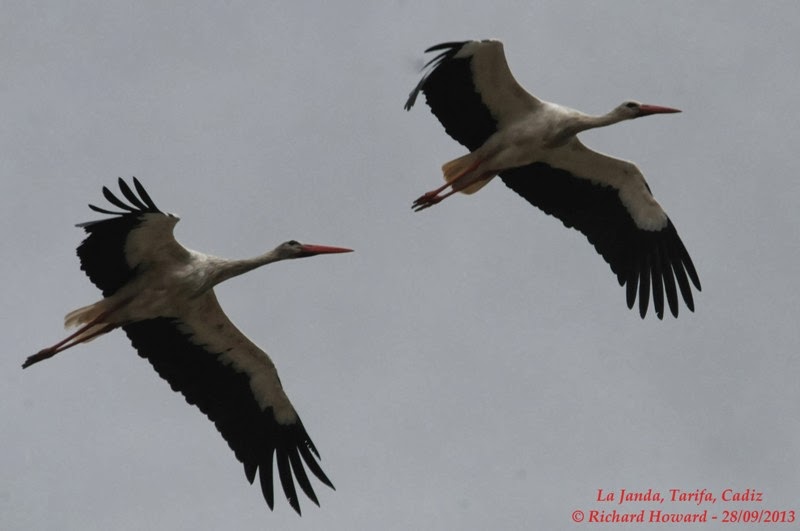
 Most were distant, but here a couple of White Storks that crossed above the car

 Wherever there was water ...


 ... there seemed to be Glossy Ibises, here with a Common Snipe

 An unusual photo - there's no Glossy Ibises - just Common Snipe and Black Winged Stilts in the paddy

 Back to normal, more Glossy Ibises ...

... and this time, with a Spoonbill


 And here in another part of La Janda

People often ask me to include photos of the actual places I visit, so here are a few of Tarifa old town itself, where we got fed and watered.

 Here the wall and gate to the old town

 Checking out the local Vegetarian Restaurant, some with more enthusiasm than others!


 Plaque on the wall of one of the buildings announcing it to be the old prison

 Typical small plaza and restaurant

 And another - friday night the town was heaving, but Saturday not ...

 My favourite restaurant - and judging by how long we had to wait for a table on friday night,
obviously a firm favourite with many others

 A shut coffee shop, but the window display tickled me!
 
Day 3 – Sunday 29th September
Once again, for our last morning, and a showery one at that, after breakfast we paid another visit to the hide at the ‘playa de los Lances’, and once again, drew a blank with the Lesser Crested Tern – just plenty of Sandwiches!  Out to sea, the recent showers had obviously stirred things up, and there were numerous Gannets and Cory’s Shearwaters, and for the first time a few Balearic Shearwaters.  Also, the Osprey was back, but having the same luck as a couple of mornings ago, and eventually after about an hour’s attempted fishing, it sat very forlorn looking on a post!  (Actually, that’s not true – they don’t sit, and the concept of forlorn-looking is a human one – no-one can tell what they are feeling, but I’m sure you can understand what I mean!).

 Osprey on one of its passes over the hide ...

 ... and about to make yet another dive for a fish ...

 I'M HUNGRY, and it's raining, and I'm feeling a little dejected!

As nothing too interesting was happening, and the skies looking very grey (we’d already had a couple of short showers while in the hide), and the forecast for it to get worse rather than better, we thought we’d go back to the hostel, collect our belongings, and make a start on the journey home, stopping off at a couple of places en route.

Our first short stop was at the Palmones Estuary, just on the other side of Gibraltar.  I remember that last year this area had given us some class birds such as Osprey and a Black Stork very close, but once again we drew a blank, best bird seen being a Spoonbill asleep viewable with ‘scopes only, and a couple of distant Booted Eagles and a Marsh Harrier, and some distant Oystercatchers in the estuary itself.

We continued our journey for a couple of hours, reaching the ‘Fuentepiedra’ lagoon mid afternoon just in time for another shower to start!  Thankfully it didn’t last long and we spent a couple of hours here in the various hides around the information centre.  In the main lagoon, the water level was probably as high as I’ve ever seen it, and there were still plenty of Greater Flamingos (I’ve put 2,000 + in my notebook, but the figure could quite easily be 5,000).  I made a rapid check for the Lesser Flamingos that bred here this year, but looking through so many birds I honestly didn’t expect to see them.
And that was about it!  Nothing too stunning to write about, but good to get somewhere different, with a good crew, not too expensive and a good time had by all.

And as a PostScript, while we were having bad weather, in Cartagena the weather was fine, and all sorts of birds were being seen, such as Pallid Harrier, and a Little Swift amongst the large numbers of Swallows and Red-rumped Swallows around (a lifer for me!), and as a further PostScript, on Monday 30th, 2 Lesser Crested Terns were seen at the playa de los Lances, Tarifa and just a bit further up the coast at Chipiona on the same day, 2 Roseate Terns, and on the 1st , 2nd  and 3rd of October, a Ruppell’s Griffon Vulture at Tarifa!!  Ah well, that’s life!

Birds seen over the weekend:
Black-necked Grebe – Podiceps nigricollis – Zampullin cuellinegro
Cory’s Shearwater – Calonectris diomedea – Pardela cenicienta
Balearic Shearwater – Puffinus mauretanicus – Pardela balear
Gannet – Morus bassanus – Alcatraz atlántico
Cormorant – Phalacrocorax carbo – Cormorán grande
Squacco Heron – Ardeola ralloides – Garcilla cangrejera
Cattle Egret – Bubulcus ibis – Garcilla bueyeraA
Little Egret – Egretta garcetta – Garceta común
Grey Heron – Ardea cinerea – Garza Real
White Stork – Ciconia ciconia – Cigüeña blanca
Black Stork – Ciconia nigra – Cigüeña negra
Glossy Ibis – Plegadis falcinellus – Morito común
Spoonbill – Platalea leucorodia – Espátula común
Greater Flamingo – Phoenicopterus roseus – Flamenco común
Mallard -  Anas platyrhynchos – Ánade azulón
Shoveler – Anas clypeata – Cuchara común
Teal – Anas crecca – Cerceta común
Black-shouldered Kite – Elanus caeruleus – Elanio común
Black Kite – Milvus migrans – Milano negro
Griffon Vulture – Gyps fulvus – Buitre leonado
Marsh Harrier – Circus aeruginosus – Aguilucho lagunero
Montagu’s Harrier – Circus pygargus – Aguilucho cenizo
Sparrowhawk – Accipiter nisus – Gavilán
Common Buzzard – Buteo buteo – Busardo ratonero
Honey Buzzard – Pernis apivorus – Abejero europeo
Short-toed Eagle – Circaetus gallicus – Culebrera europea
Booted Eagle – Hieraaetus pennatus – Aguililla calzada
Osprey – Pandion haliaetus – Águila pescadora
Kestrel – Falco tinnunculus – Cernícalo vulgar
Lesser Kestrel – Falco Naumanni – Cernícalo primilla
Hobby – Falco subbuteo – Alcotán
Peregrine – Falco peregrinus – Halcón peregrino
Pheasant – Phasianus colchicus – Faisán vulgar
Red-legged Partridge – Alectoris rufa – Perdiz roja
Moorhen – Gallinula chloropus – Gallineta común
Coot – Fulica atra – Focha común
Oystercatcher – Haematopus ostralegus – Ostrero
Black-winged Stilt – Himantopus himantopus – Cigüeñuela
Avocet – Recurvirostra avosetta - Avoceta común
Ringed Plover – Charadrius hiaticula – Chorlitejo grande
Kentish Plover – Charadrius alexandrinus – Chorlitejo patinegro
Grey Plover – Pluvialis squatarola – Chorlito gris
Lapwing – Vanellus vanellus - Avefría europea
Sanderling – Calidris alba – Correlimos tridáctilo
Dunlin – Calidris alpina – Correlimos común
Knot – Calidris canutus – Correlimos gordo
Ruff – Philomachus pugnax – Combatiente
Common Snipe – Gallinago gallinago – Agachadiza común
Bar-tailed Godwit – Limosa lapponica – Aguja colipinta
Redshank – Tringa totanus – Archibebe común
Green Sandpiper – Tringa ochropus – Andarríos grande
Wood Sandpiper – Tringa glareola – Andarríos bastardo
Common Sandpiper – Actitis hypoleucos – Andarríos chico
Black-headed Gull – Larus ridibundus – Gaviota reidora
Audouin’s Gull – Larus audouinii – Gaviota de Audouin
Yellow-legged Gull – Larus michahellis – Gaviota patiamarilla
Lesser Black-backed Gull – Larus fuscus – Gaviota sombría
Sandwich Tern – Sterna sandvicensis – Charrán patinegro
Little Tern – Sterna albifrons – Charrancito
Black Tern – Chlidonias niger – Fumarel común
Rock Dove/Domestic Pigeon – Columba livia – Paloma bravía
Woodpigeon – Columba palumbus – Paloma torcaz
Collared Dove – Streptopelia decaocto – Tórtola turca
Turtle Dove – Streptopelia turtur – Tórtola europea
Little Owl (H) – Athene noctua – Mochuelo
Tawny Owl (H) – Strix aluco – Cárabo común
Alpine Swift – Apus melba – Vencejo real
Common Swift – Apus apus – Vencejo común
Pallid Swift – Apus pallidus – Vencejo pálido
Kingfisher – Alcedo atthis – Martín pescador
Hoopoe – Upupa epops – Abubilla
Green Woodpecker (H) – Picos viridus – Pito real
Skylark – Alauda arvensis – Alondra común
Crested Lark – Galerida cristata – Cogujada común
Calandra Lark – Melanocorypha calandra – Calandria común
Short-toed Lark – Calandrella brachydactyla – Terrera común
Swallow – Hirundo rustica – Golondrina común
Red-rumped Swallow – Hirundo daurica – Golondrina dáurica
House Martin – Delichon urbicum – Avión común
Sand Martin – Riparia riparia – Avión zapador
Blue-headed Wagtail – Motacilla flava – Lacandera boyera
White Wagtail – Motacilla alba alba – Lavandera blanca
Common Redstart – Phoenicurus phoenicurus – Colirrojo real
Whinchat – Saxicola rubetra – Tarabilla norteña
Stonechat – Saxicola torquatus – Tarabilla común
Northern Wheatear – Oenanthe oenanthe – Collalba gris
Black-eared Wheatear – Oenanthe hispanica – Collalba rubia
Blue Rock Thrush - Monticola solitarius - Roquero solitario
Blackbird – Turdus merula – Mirlo común
Cetti’s Warbler (H) – Cettia cetti – Ruiseñor bastardo
Fan-tailed Warbler – Cisticola juncidis - Buitrón
Sardinian Warbler – Sylvia melanocephala – Curruca cabecinegra
Spotted Flycatcher – Muscicapa striata – Papamoscas gris
Pied Flycatcher – Ficedula hypoleuca – Papamoscas cerrojillo
Blue Tit (H) – Parus caeruleus – Herrerillo común
Great Tit – Parus major – Carbonero común
Southern Grey Shrike – Lanius meridionalis – Alcaudón real
Magpie – Pica pica – Urraca
Carrion Crow – Corvus corone – Corneja común
Raven – Corvus corax – Cuervo
Jackdaw – Corvus monedula – Grajilla
Common Starling – Sturnus vulgaris – Estornino pinto
Spotless Starling – Sturnus unicolor – Estornino negro
House Sparrow – Passer domesticus – Gorrión común
Spanish Sparrow – Passer hispaniolensis – Gorrión moruno
Chaffinch – Fringilla coelebs – Pinzón vulgar
Serin – Serinus serinus – Verdecillo
Greenfinch – Carduelis chloris – Verderón común
Goldfinch – Carduelis carduelos – Jilguero
Linnet – Carduelis cannabiona – Pardillo común
Corn Bunting – Miliaria calandra – Triguero

(H) denotes heard only

Should you wish to keep more up to date with what’s being seen, look me up on ‘facebook’ under ‘Richard Howard’.

Ciauu