Showing posts with label marina de Carmoli. Show all posts

Wednesday, 10 December 2014

Mar Menor roundup


Hi all.
 
I’ve not made a blog entry for a few weeks now, basically due to the lack of action on the birding front.  Everything has been really quiet, with until last weekend mild conditions, rainy on a few days.  The rain has helped at the old EDAR (sewage farm) of El Algar, there now being an almost permanent pool of water in the first lagoon, which has enticed a group of Lapwings to hang around with up to 10 birds (Lapwings in this area have been very scarce in the last few years).  Also there, have been Water Pipits and a single Grey Wagtail on and off.

I’ve made a few visits to the lighthouse gardens at Cabo de Palos just on the offchance that something might have come in, but there it’s also pretty quiet with just the usual Blackbirds, Stonechats, Black Redstarts, Sardinian Warblers, Chiffchaffs, Starlings of both species (there’ll be a Rosy one day!), Crag Martins, Robins, Meadow Pipits, House Sparrows, Collared Doves and the occasional Blackcap.  You can tell how quiet it’s been if I say that the outstanding bird there has been a possible Barbary Dove in amongst the Collared Doves (it wouldn’t call/sing, so I couldn’t confirm it).

Plenty of mixed Starlings at the lighthouse gardens ...
 
... and this possible Barbary Dove

Calblanque has similarly been quiet with even the usual Audouin’s Gull build-up failing to happen, although there’s always four or five around.

 In Calblanque, some of the winter visitors - here Black Redstart ...
 
 ... and Chiffchaff
And a resident, Thekla Lark

On the Mar Menor, a build-up of Great Crested and Black Necked Grebes has been noticeable (and it’s always worthwhile looking through them just in case there might be a diver or seaduck amongst them).  At several places along the Mar Menor (e.g. desembocadura de la Rambla de Albujon; club nautico Los Urrutias) there are Kingfishers wintering, and in amongst the few Turnstones and Ringed Plovers visible from Los Urrutias to the desembocadura Rambla de Albujon, I’ve had the occasional Knot, and on the 23rd November almost trod on a Jack Snipe along the tideline.  You also occasionally hear Bluethroats calling, although they are not easy to see, and in the reedbeds the occasional Penduline Tit can be heard on windless days.
 Typical birds along the Mar Menor - here Curlew ...
 ... Jack Snipe ...
... mixed wader flock of Turnstone, Dunlins and Knot  ...
 ... Knot ...
 ... and again ...

... Bluethroat ...
 
 ... Turnstone ...

 ... Ringed Plover ...
 ... Dunlins ...
... and Grey Plover in the winter sun

At the Marina de Carmoli, just beyond Los Urrutias and Punta Brava on the Mar Menor, watching the evening harrier roost, I’ve had up to 9 Marsh Harriers and a single ‘ringtail’ Hen Harrier, but no sign of the other smaller ‘ringtail’ that I mentioned in my last post.  However a couple of weeks ago a friend asked for my help in identifying a small harrier that he had photographed close to Cartagena hunting over a farm reservoir, and it turned out to be a ‘ringtail’ed juvenile/female Montagu’s Harrier, and could easily be the bird that I saw and mentioned in my last post.

Record shot of the 'ringtail' Hen Harrier
 
At the Salinas at San Pedro del Pinatar, bird numbers seem very low – even the Greater Flamingos – although if you stick at it, there is a reasonable selection of species – on my last visit I had Greater Flamingo, Grey Heron, Cattle Egret, Little Egret, Spoonbill (2 in amongst the Grey Herons), Black-tailed Godwit, Avocet, Black Winged Stilt, Spotted Redshank, Redshank, Greenshank, Dunlin, Little Stint, Common Sandpiper, Ringed and Kentish Plover, Ruff, Kingfisher, Mallard, Moorhen and Kestrel, plus all the usual passerines such as Black Redstart, Stonechat, Chiffchaff, Meadow Pipit, White Wagtail, Greenfinch, Serin, Chaffinch and House Sparrow.

At the salinas at Marchamalo there is now a constant group of Greater Flamingos, and Shelduck and Avocet numbers are starting to build.  Last weekend a surprise was the number of Spotted Redshanks (12) and the winter group of Golden Plovers that roost on one of the lagoon wall has finally arived, with 79 being seen.
 
 Feeding Spotted Redshanks ...

... and a short video of them ...

... and some of the Golden Plover

 And round at the Playa Paraiso side, more Chiffchaffs
 
With regards to woodlands birds I have been several times now to the woods between the ‘La Manga Club’ and Portman (Monte Cenizas), looking for winter birds, but the specific bird I have been searching for, Goldcrest, just hasn’t been there (plenty of Firecrests, but no Goldcrests!).  This last weekend though I did see my first Siskins of the year.  Other birds of interest there were Chiffchaff, Chaffinch, Crested Tits, Wren, Robin, Long-tailed Tit, and Sparowhawk.

 The Firecrests seem more common this year in the woods


 Record shot of a surprise bird seen last weekend - Siskin

My only ‘out of area’ visit was on Saturday when I went up to the top of Sierra Espuña, looking for winter thrushes and Alpine Accentors, but my visit coincided with the first really cold spell of the winter, and although I had thermal gear on including thermal gloves, by the time I reached the ‘Pozos de Nieve de Murcia’, my fingertips had turned purple, there was a gale blowing and the spring I normally wait by was dry (and the only other water was in the form of thick ice-covered puddles), so having seen just a few Mistle Thrushes and a single Ring Ouzel, I came back.  Was I ever pleased to find the restaurant at the bottom open even though it was a public holiday – the hot coffee was more than welcome!

A word of warning for anyone who tries going up to the radar station at the top – for those who know the area, the military zone has been extended so you can only go as far as the ‘layby’ where you have to turn around.

And that’s all for now folks, so till my next post, happy birding!!

Ciauu

Monday, 10 March 2014

The winter birds are off!


After writing last week how the spring migration has begun, this week spring/summer visitors have been few and far between, and the majority of migrants have been winter visitors making their way north.

On a national scale, the major movements have been of Common Cranes and Black Kites heading north.  At Gallocanta, which is THE major stop-off for Cranes before they cross the Pyrenees heading for more northerly latitudes, the single Sandhill (or Canadian) Crane that has been seen over the past couple of years now, was once again spotted amongst the thousands of Common Cranes for a couple of days, and then on one day, a massive group of 40,000 Cranes took off not to be seen again.  That must have been some spectacle, both the seeing and the hearing of them. 
News from Tarifa in the south has been that there have also been good movements of raptors and other soaring birds across the straits of Gibraltar, and at other points of the south coast, both Subalpine Warbler and Bee-eater have been seen.

In this coastal neck of the woods, the last week has been typified with sunny days but with cold NE or NW winds – not the sort to entice the summer visitors.  Last Tuesday (4th March) I paid an early morning visit to the lighthouse gardens at Cabo de Palos.  There were some signs of movement, but as I’ve already said, mainly of winter visitors.  Plenty of Black Redstarts, and a few Crag Martins, Stonechats, Blackbirds, Meadow Pipits, Sardinian Warblers and Chiffchaffs and a singles of Robin, Greenfinch and Serin. On the way home I called into the Playa Paraiso end of Marchamalo salinas where I had 7 Little Stints, 2 Little Ringed Plovers and a couple of male Blue-headed Wagtails.

 One of the Little Ringed Plovers ...

... and one of the Blue-headed Wagtails 

In the afternoon, I went round the western end of the Mar Menor, where in one of the farm reservoirs, there were still a group of five Ferruginous Ducks, which from what I could see, were all males.
 Two of the five Ferruginous Ducks ...

... I couldn't get all five in the same shot, just four together
 
Having a look on the Mar Menor itself, things there have now quietened down considerably, with just 4 Greater Flamingos, 18 Black Necked Grebes and only 10 Great Crested Grebes, and a single male Common Pochard.  As I was there and it was the right time of day, I stopped for a while at the Marina de Carmoli and had three Marsh Harriers hunting over their roost, and surprisingly, the adult female Pallid Harrier, which I thought would have gone by now.

On Thursday afternoon (5th March), I thought I’d have another look at the park in Santa Ana on the other side of Cartagena for the Redwings that had been there the week before, but no luck with them – I think they’ve definitely gone.  What I did see there though, something I haven’t seen for a number of years now, was a juvenile Crossbill which was calling from a branch almost over my head for a few minutes.  I’d forgotten just how ‘spotty’ they are!

Juvenile Crossbill in the park at Santa Ana

From there I went over to the Salinas at San Pedro del Pinatar in the hope of seeing Common Scoter on the sea just to the north of the port.  I had no luck with these either, but did have in the 15 minutes or so that I was there, 15 adult Gannets fly south.
Waders were pretty thin on the ground at the Salinas, the only numbers of note being of Avocets and Black Winged Stilts, plus singles of Spotted Redshank and Little Stint, and a group of eight Black-tailed Godwits and three Ruff.

 One of three Ruff seen at San Pedro salinas

A single Spoonbill flying over me into the lagoons was very nice though.  Moving round to El Mojon, there were the usual Turnstones and Sanderlings on the beach, and a couple of small groups making 60 in total, of Cormorants flying off out to sea, looking like they wouldn’t be returning.   A single Bluethroat along the canal was a nice find too – I would have thought that these too would have gone by now.

At Marchamalo Salinas (Cabo de Palos) water has once again started to be pumped in – to the extent that the main lagoon on the Cabo de Palos side is now too deep for smaller waders, and the best place to see them is in the afternoon from the Playa Paraiso side.  On Thursday afternoon (6th March), I had a group of 21 Little Stints plus 4 Little Ringed and 4 Kentish Plover there.

On Friday, 7th March I took an early afternoon walk around the lighthouse gardens at Cabo de Palos.  As seems to be the norm at the moment, the afternoons are very quiet and the only birds of note were a group of five ‘Spotty’ Starlings in amongst the Spotlesses, and a male Blue Rock Thrush, plus a few Black Redstarts.

 Amongst the Spotless Starlings, still a few of their 'Spotty' cousins

A male Sardinian Warbler giving alarm when a cat was trying to find its nest

 On the rocky area by the seawatching point, this Blue Rock Thrush dropped in ...

 ... and on a nearby fence post was this male Black Redstart

Later at the sailing club at Los Urrutias, the Great White Egret was once again present, together with the Avocet that has decided to make the place its home, and a few Slender-billed and Black-headed Gulls and a solitary Sandwich Tern, and along the beach a couple of Little Ringed Plovers.

 Little Ringed Plover along the beach ...

 ... while out in the Mar Menor this Great White Egret was hunting

The now resident Avocet, together with Slender-billed Gulls and a Sandwich Tern

From there, I took a walk along the rambla de Albujon.  The reeds that were cut a few months ago are growing well now, and there I had a couple of Green Sandpipers and Little Ringed Plovers, 8 Common Snipe plus 4 Blue-headed Wagtails, 5 Swallows, at least 2 Water Pipits, at least 5 Meadow Pipits, a male and female Reed Bunting, Kingfisher and at least 15 Chiffchaffs.
Finally on Sunday (9th March), I took an early wander around the lighthouse gardens again at Cabo de Palos, but the only birds of note were a male Blackcap and a couple of Gannets out at sea.  From there I went over to the ‘Arenal’ at Los Nietos (between Los Nietos and Los Urrutias), and despite the wind that got up, I heard and saw one Richard’s Pipit.

So here’s hoping that this week we might have some decent arrivals of summer migrants (and if the weather forecasts are right, Thursday morning might be worth a look although possibly wet and windy).


Chauu


Thursday, 13 February 2014

Sierra Espuña – Ring Ouzel country


Hi all,
 
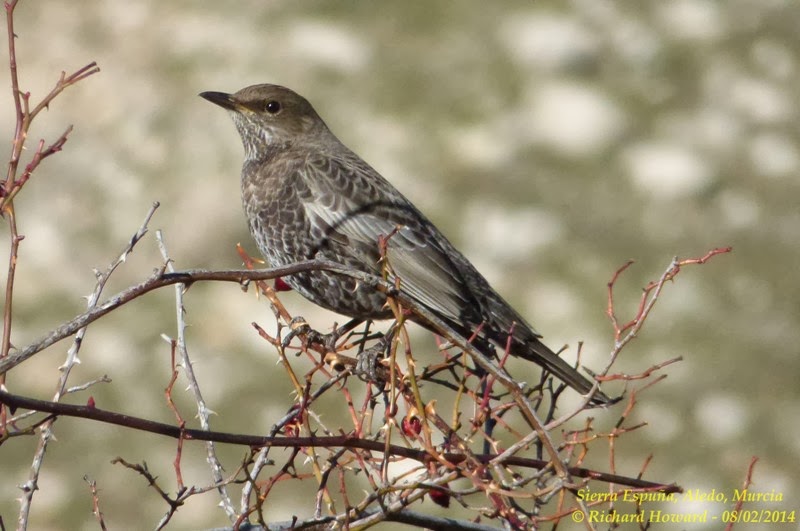
Last Saturday (8th February) I decided it was high time to take a trip up to the nearest sierras to me, the Sierra Espuña. A mountainous area with pine forests on the lower slopes, and open meadow and rocky areas up on the top at a height of around 1500 metres. Apart from being very picturesque, my reason for going there was in the hope of seeing some of the northern thrushes, such as Redwing or Fieldfare.  I had no luck with these, and didn’t even see Mistle or Songthrush, but the lack of these was made up for by seeing good numbers of Ring Ouzels. 

Coming from Essex where you occasionally see one or maybe two on autumn passage, to see flocks of them flying around and calling to each other (and even one or two singing) is quite something.  I would estimate that over the course of the morning I saw a minimum of 30 of them, with one flock flying overhead made up of 15 birds.  These birds that come from Great Britain and presumably Scandinavia and the Alps, winter in numbers in the higher parts of Murcia (Espuña, Revolcadores) and around Nerpio (Albacete).

The zone where I see them are the ‘pozos de la nieve de Cartagena’, an open meadow area with many broken down buildings in the form of bee-hives.  This is where, in years gone by, before refrigeration and when there was a lot more snow around, the snow would be shoveled into the wells and packed down, forming ice, which would then be cut out and transported by mules to Cartagena and Murcia.  There are varios areas of ‘pozos de la nieve’, the most important being the 'pozos de la nieve de Cartagena' and 'pozos de la nieve de Murcia'.  The Murcia ‘pozos’ are off in a different direction, and one of the ‘pozos’ there has been restored back into its original state for visitors to see.

 'Sierra Espuña' as seen from the saladares del Guadalentín

 View of the top of Espuña from the entrance

 Sign explaining the Pozos

 Ruin of one of the 'pozos'

 View from the top of Espuña looking over neighbouring countryside

The 'Cartagena pozos' are in ruins, and seldom visited.  There is also there is a well here which attracts the birds, especially in a dry winter such as we are having this year.

So, setting out from Los Belones at just after 8 a.m., I arrived at the entrance to the Espuña park at just after 9-30, and then spent the next half hour slowly climbing up on the narrow hairpin mountain roads.  Parking the car, a further 20 minutes walk brought me to where I wanted to be.  Conditions entering the park, clear skies, no wind and a pleasant 12ºC; conditions on the top still mainly clear skies with quite heavy grey clouds passing rapidly over, wind about force 4 south westerly and temperature I would guess at about 4ºC!  Gloves needed!

I spent a couple of hours close to some wild rose bushes next to the well, which is where all the thirsty birds would come down and perch before dropping to the ground to have a drink.  It was quite a spectacle.  Apart from the Ring Ouzels, there were also Rock and Cirl Buntings, Crested and Coal Tits, Green, Gold and Chaffinches, and I also had an adult Golden Eagle fly over (although I saw it too late to get any decent photos).

 
  View of the well area
Some of the birds seen:

 Cirl Bunting

 Coal Tit

 Male Greenfinch
 Goldfinch

 Male Crossbill

 Rock Bunting

 Crested Tit

Male and female Crossbill


And a few photos of the commonest bird there, Ring Ouzel

At around 12-30, I decided it was time to leave as the clouds were gradually building up making it feel cold, and I still had a few places to visit, so after a quick look at the very top of the mountain for Alpine Accentors (no luck – I think the winter’s too mild), I came back down to a wooded area where I found some Short-toed Treecreepers, and more Coal and Crested Tits, and I finally left Espuña at around 3pm.


One of the Short-toed Treecreepers seen

As it was almost on the way home, I called into the Alhama de Murcia sewage farm (EDAR) in the hope of some hirundines and possibly waders and gallinule, but it was very quiet there – the only wader a single Common Snipe, and there were no hirundines or Purple Gallinules at all.

Crossing the motorway, I called into the ‘saladares del Guadalentín’, but here too was very quiet and cold, and the only birds of note were a group of 12 Magpies together and a single Dartford Warbler!

I didn’t stay there too long, so getting back to the Mar Menor earlier than I’d anticipated and it being still light (about an hour before sunset), I decided to have a look over the ‘marina de Carmolí’ for harriers going to roost. I spent an hour there seeing only four harriers, but it was well worth it – I saw three Marsh Harriers (including an adult male) and an adult female Pallid Harrier!

Record shot of the female adult Pallid Harrier

Not a bad day!!

The following morning, I joined up with the volunteers of the ‘Asociación Calblanque’ who were clearing up the old salt storage area of the ‘Salinas de Rasall’ in Calblanque.  As always there was a good number of Audouins Gulls there (I counted a minimum of 225), and in amongst them the adult Common Gull was once again present.  Other birds seen in the open Salinas area were 10 Shelduck, Mallard, Little Egret, Common Sandpiper and Yellow-legged, Slender-billed and Black-headed Gulls.

 Mixed in with the Audouin's Gulls, a single Common Gull

Part of the group of Audouin's Gulls

And that’s about all for now, so good birding!!

Ciauu